 |
Last Update:
Thursday November 22, 2018
|
| [Home] |
|
Volume 21 Issue 1 Pages 1 - 55 (July 2004) Citation: Nakano-Oliveira, E. Fusco, R., Santos, E.A.V. dos, Monteiro-Filho, E.L.A. (2004) New Information About The Behavior Of Lontra Longicaudis (Carnivora: Mustelidae) By Radio-Telemetry . IUCN Otter Spec. Group Bull. 21(1): 31 - 35 New Information About The Behavior Of Lontra Longicaudis (Carnivora: Mustelidae) By Radio-Telemetry Eduardo Nakano-Oliveira1,2, Roberto Fusco1, Etiene A. V. Dos Santos1, Emygdio L. A. Monteiro-Filho1,3 1 Instituto de Pesquisas Cananéia,
IpeC, Brazil e-mail: edunakano@yahoo.com
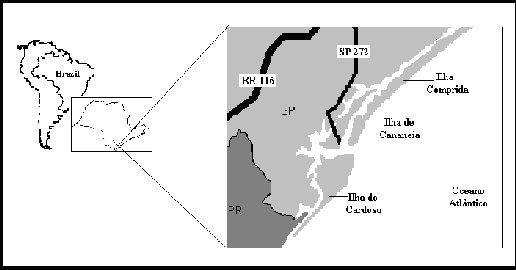
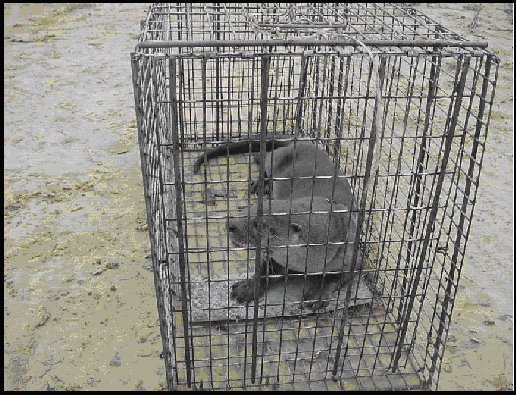
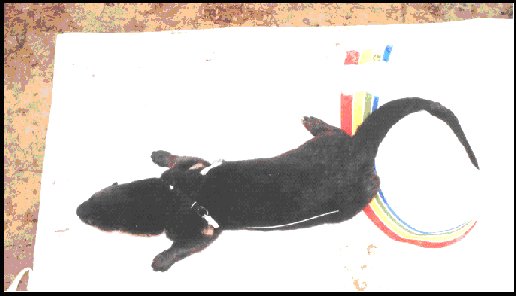
INTRODUCTION During the development of a study about a community of carnivorous mammals in the area of the south coast of the State of São Paulo, southeast of Brazil (of 25°00' to 25°04' S and 47°54' to 47°56' W), (Figure 1), a male otter (1,23 m and 10,00 kg) was captured in a live-trap (Figure 2). The capture happened on September 12th 2003 in an area of mangroves 100 m from Jacó River and 300 m from Trapandé Bay. The use of collars as a form of adapting the radio-transmitter is not the most appropriate for mustelids, due to its lanky body, funneled neck and head, and short ears, so we adapted the radio-transmitter on two collars so that it hindered the withdrawl of the equipment by the animal (Figure 3). Aiming at verifing the efficiency of the adaptation, we were careful to keep it in observation until the following day. Approximately 24 hours after the capture, the male didn’t seem to be bothered by the radio-transmitter, it had already fed itself and was taking care of its fur as usual and, therefore, it was released. Apparently the equipment was well tied to the otter and it didn't disturb the animal while it walked, swam or fed. For a period of 35 days the otter was monitored, allowing us to verify that: 1 - the animal used at least three burrows without communication between them; 2 – the most used burrow was at a distance of 2,6 km from the capture place; 3 - this individual usually moved between Cananéia Island and Comprida Island, which are separated by an estuary whose medium width is of approximately 1 km; 4 – twice, it spent a long period, between 07:00am and 02:00pm, and between 8:00pm and 11:00pm, on a small island of approximately 0,06 Km2 (Pai Mato Island) where a muddy substrate prevails, not allowing the construction of a burrow.
After this period, the signal emitted by the transmitter stopped varying; leading us to suppose that the otter was dead or it had removed the equipment with the transmitter. For about 5 days the signal was traced and finally the radio-transmitter was found in perfect condition inside a burrow on the coast of the estuary on a nearby island (Comprida Island). The hypothesis that the otter had removed its own collar is based on the fact that did not find signs of blood or struggle at the place or on the collar and it was still closed, excluding the possibility that the animal had been predated upon or that hunters had removed the collar. This hypothesis was confirmed 12 days after the radio-transmitter had been found when the male was seen feeding itself peacefully at 07:20 pm on the beach 300 m far from the burrow where we found the transmitter. Identification was possible due to the fact that we had shaved a small part of its side at the moment of capture to identify it in case it removed the collar.
In spite of the little time that the otter stayed with the radio-transmitter, the data obtained are of relevant importance because they show an unknown activity pattern; besides showing, over a short period, some pattern of use of burrows. Among the 13 recognised species of otters, L. longicaudis is one of the less studied, being considered ‘vulnerable’ in Brazil due to a lack of knowledge (FOSTER-TURLEY, 1990). Until recently, knowledge about the ecology and behavior of this species were based on studies about diet and use of shelters in different ecosystems (BLACHER, 1987, 1991; GALLO, 1991; PARERA, 1993, SOLDATELI and BLACHER, 1996; PARDINI, 1998; PARDINI and TRAJANO, 1999; WALDEMARIN and COLARES, 2000; CASTRO-REVELO and ZAPATA-RÍOS, 2001; QUADROS and MONTEIRO-FILHO, 2000, 2002; CEZARE et al. 2002) and the activity patterns were extrapolated from studies accomplished with the European otter Lutra lutra and with the North American otter Lontra canadensis. However, even if the otter had removed its radio-collar, it didn’t cause any damage to the individual and it allowed the registration of behaviour patterns that had not been described. Based upon the adapted radio-transmitter used, new perspectives open up for the effective study of this species, thereby increasing the possibilities of obtaining data about activity patterns and home range for L. longicaudis. Acknowledgements - to Instituto de Pesquisas Cananéia, IPeC, Fudação O Boticário de Proteção à Natureza and The Nature Conservancy do Brasil for all the support; to Luciana Nakano C. de Oliveira for the revision of the paper; to Fernando, Ana Carolina and Cintia for helping in the capture process; to Rafael Xavier for helping in the monitoring the otter; to Centro Nacional de Pesquisas para Conservação de Predadores Naturais CENAP/IBAMA for the permissions for catching carnivores (licence # 044/03). REFERENCES BLACHER,
C. 1987. Ocorrência e preservação de Lutra
longicaudis (Mammalia: Mustelidae) no litoral de Santa Catarina. Boletin
da FBCN, 22, 105-117. Résumé : Pourquoi Les Philosophes DevraNouvelles Donnees Sur Le Comportement De Lontra Longicaudis (Carnivora : Mustelidae) Obtenues Par Radio-Pistage Une loutre a été capturée et équipée
d’un émetteur-radio, au cours d’une étude sur
la population de mammifères carnivores de la région de
mangroves de la côte sud de l’état de Sao Paulo, situé au
sud-est du Brésil. Cette étude a permis de vérifier
que : 1 - la loutre a utilisé au moins trois terriers qui ne communiquaient
pas entre eux. 2 - le terrier le plus utilisé se situait à une
distance de 2,6 km du lieu de capture. 3 - cet individu se déplaçait
habituellement entre deux îles, séparées par un estuaire
ayant une largueur de 1 km. 4 – il a passé une longue période
sur une petite île de 0,06 km², où le substrat essentiellement
boueux ne permet pas le creusement d’un terrier. Malgré le
fait que la loutre n’ait porté l’émetteur que
pendant une courte période, les données obtenues se révèlent être
d’un grand intérêt, car elles montrent un cycle d’activité encore
inconnu, en plus de mettre en évidence la stratégie d’occupation
des terriers sur une courte durée. Bien que la loutre ait retiré son
collier émetteur, celui-ci n’a causé aucun dommage à l’animal
et a révélé un schéma comportemental encore
non décrit. Ainsi, le collier émetteur que nous avons adapté à la
loutre et les observations effectuées ouvrent de nouvelles perspectives
pour l’étude de Lontra longicaudis et augmente
les possibilités
d’obtenir des informations sur l’activité et la répartition
de l’espèce. Resumen |
| [Copyright © 2006 - 2050 IUCN/SSC OSG] | [Home] | [Contact Us] |