IUCN/SSC Otter Specialist Group Bulletin

|
IUCN/SCC Otter Specialist Group Bulletin Volume 27 Issue 2 Pages 59 - 122 (June 2010) Citation: Goldthorpe, G., Shepherd, C., Hogg, S. and Leupen, B. (2010). Predation of water monitor lizard (Varanus salvator) by smooth-coated otter (Lutrogale perspicillata) in Peninsular Malaysia. IUCN Otter Spec. Group Bull. 27 (2): 78 - 84 Predation of water monitor lizard (Varanus salvator) by smooth-coated otter (Lutrogale perspicillata) in Peninsular Malaysia Gareth Goldthorpe1, Chris Shepherd2, Stephen Hogg3 and Boyd Leupen4 1Fauna & Flora International, Georgian Carnivore Conservation Project, 12a Abashidze Street, Tbilisi, 0179, Georgia. Email ggoldthorpe@gmail.com |
|
Abstract: A smooth-coated otter (Lutrogale perspicillata) was observed and photographed attacking and killing a water monitor lizard (Varanus salvator) in a small pond at the Forestry Research Institute, Malaysia, Kuala Lumpur. This is the first time such an interaction has been recorded between these species and possible explanations for the behaviour are discussed. |
| Keywords: Lutrogale perspecillata, monitor lizard, Varanus, diet, predation, Malaysia |
| Française | Español |
Otters, as a group, are fairly generalist in their diet taking almost anything that is either plentiful or easy to catch; a behaviour that is largely governed by their fast metabolism and subsequent need to consume large quantities of food each day (MacDonald, 2001). As such they have been observed taking young birds, frogs, crabs and even small snakes. However, little is known about the specific feeding preferences of the large smooth-coated otter (Lutrogale perspicillata) though it is considered to be, predominantly, a piscivore (Yeen Ten Hwang and Lariviere, 2005). Weighing in the region of 7-11 kg with a total length of around 100-120 cm (Francis, 2008) it is the largest of the four species found in this region.
Work in India by Hussain and Choudhury (1998) suggests that the smooth-coated otter shows a distinct preference for just two species of fish whilst, in Java, research found a distinct preference for fish supplemented with freshwater prawns (Melisch et al., 1996). Accounts of smooth-coated otters predating on species other than fish are rare though they are known to feed on rats, snakes and insects (Yeen Ten Hwang and Lariviere, 2005). This paper gives an account of a smooth-coated otter attacking and apparently killing a water monitor (Varanus salvator) in Peninsular Malaysia.
On 29th March 2009, at around 08.00, an adult smooth-coated otter, of unknown sex, was observed in a pond at the Forestry Research Institute, Malaysia (FRIM) (3°13'49''N - 101°38'00''E) (Figure 1). The pond is approximately 200 m in diameter and surrounded by a mixture of by trees and lawns, the latter leading to a road around 50 m from the pond. Although otters have been observed there by the authors before, sightings are considered to be a rare event.
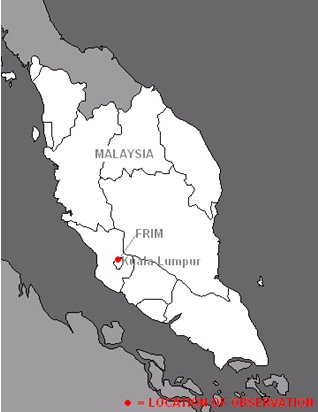 |
| Figure 1. Location of the observation |
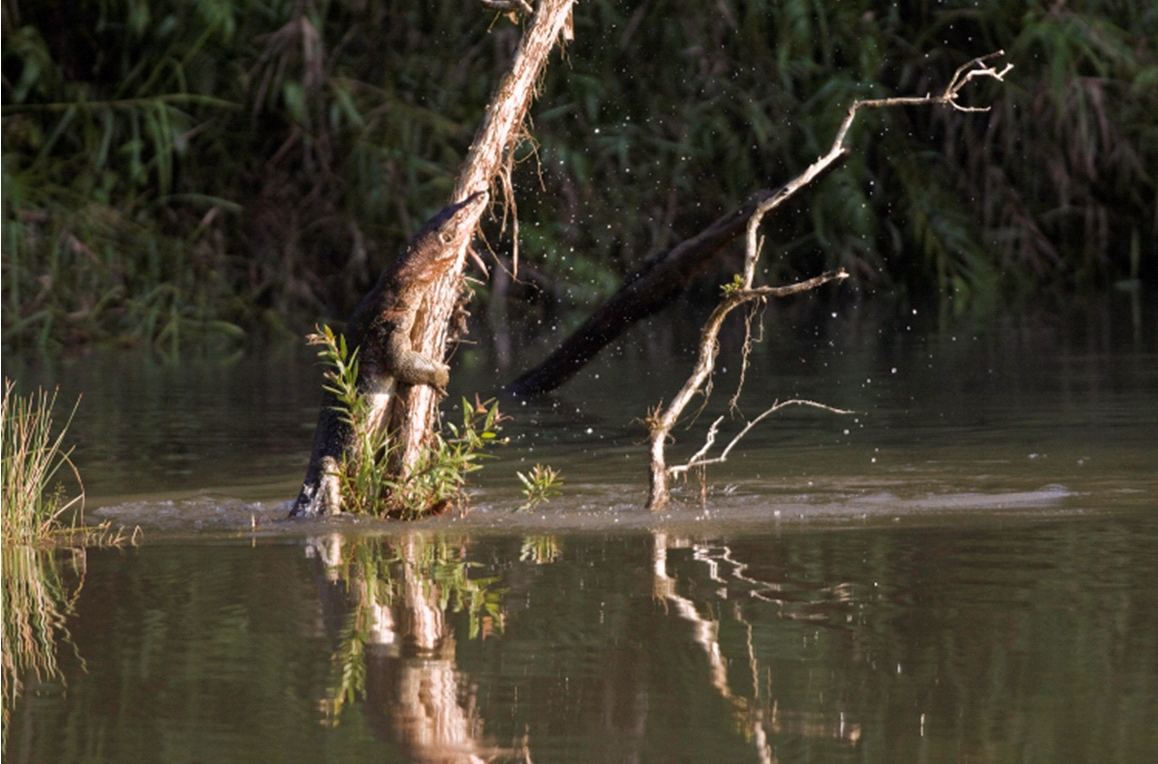
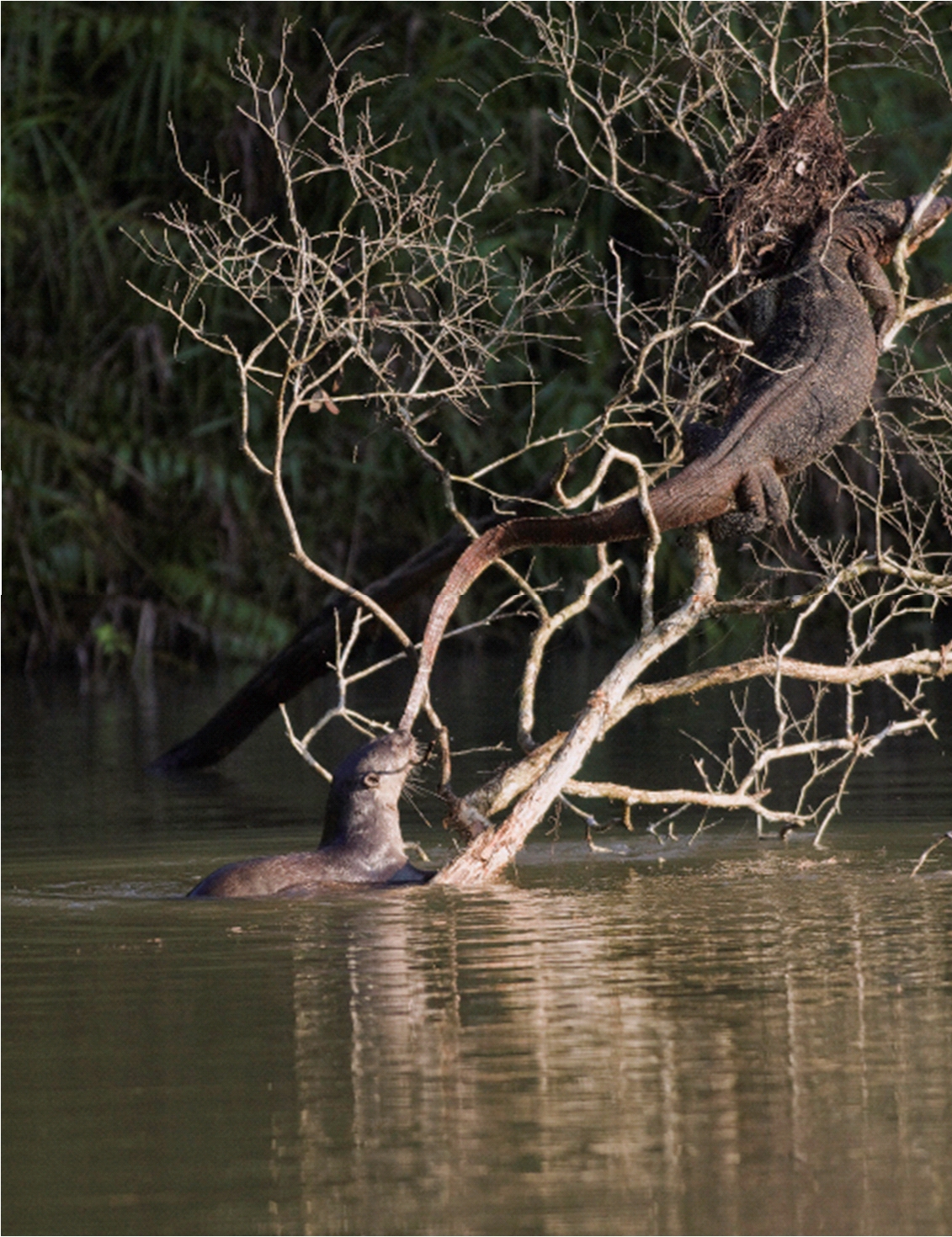
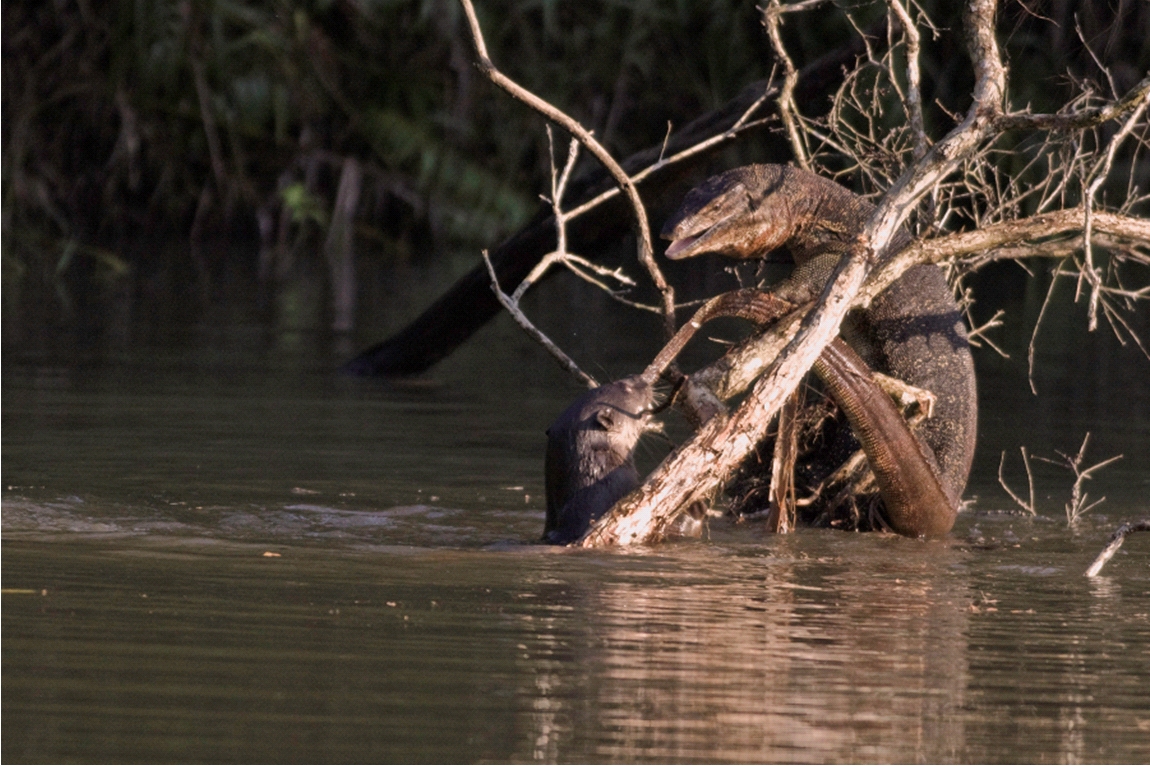
The otter was initially observed catching and eating small fish at several locations within the pond over a half-hour period. At approximately 08:30 a large water monitor lizard, approximately 110-120 cm in length, swam across the pond and climbed onto a small tree protruding from the water (Figure 2). Within seconds the otter appeared at the base of the tree and grabbed the monitors' tail in its mouth (Figure 3). Although the monitor resisted the efforts of the otter, turning its head repeatedly as if trying to bite it (Figure 4), it was eventually pulled into the water where the otter immediately climbed onto its back (Figure 5).
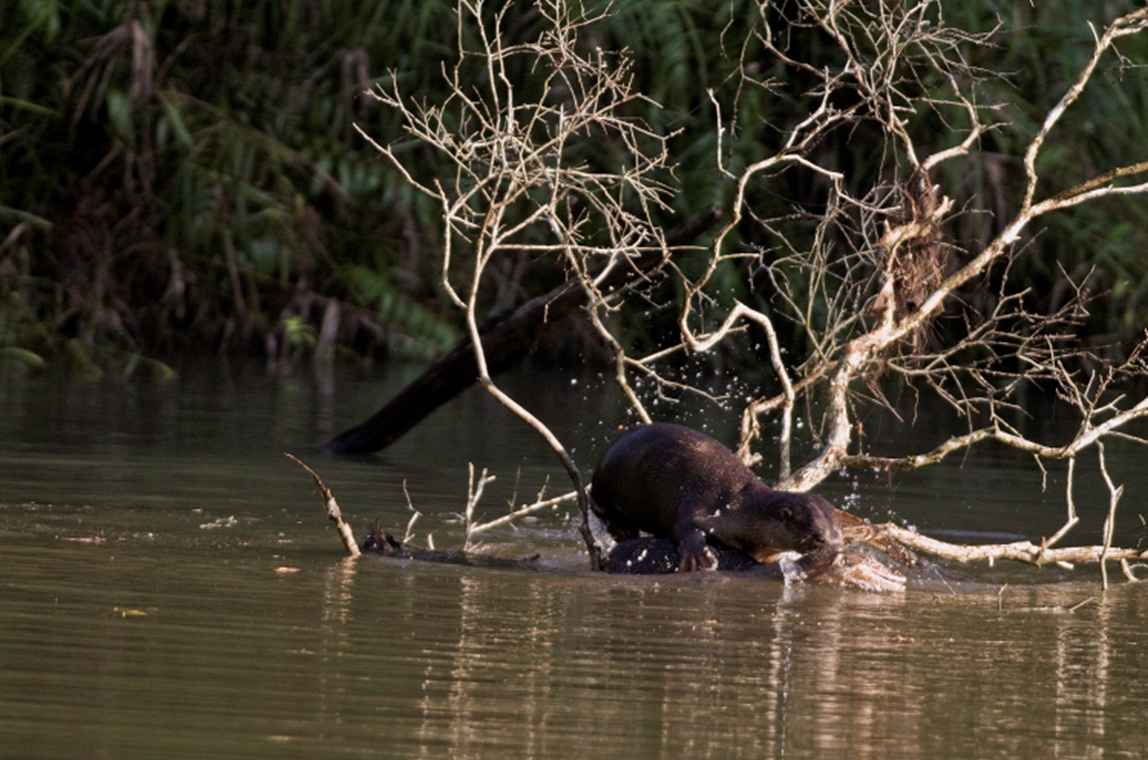
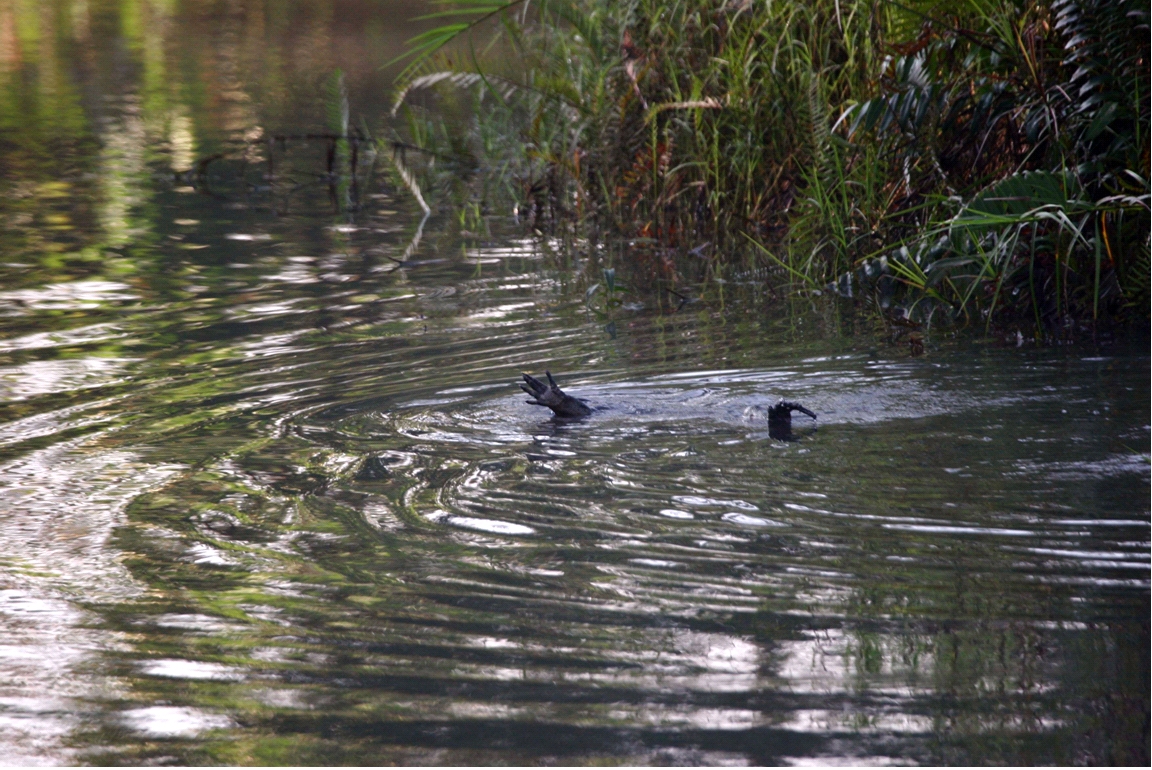
The ensuing struggle lasted several minutes during which the monitor seemed to put most of its effort into escape. The otter, however, seemed intent on overpowering it and dragged it underwater several times (Figure 6). At one point the otter was seen biting the back of the monitors' neck and, though it was not clear if this was a fatal bite, the monitor did cease to struggle and soon after was seen floating on its back. At this point it was assumed to be dead, though this was never actually verified. The otter then gripped the “carcass” in its jaws and swam with it back to the area where the encounter had begun. Here it appeared to push the body under a partly submerged tree-limb, as if caching it; a behaviour that is not, to this authors knowledge, recorded elsewhere.
This appears, then, to be the first record of a smooth-coated otter attacking and killing such a large animal. The motivation for the attack is unclear as, whilst simple predation would be the most obvious explanation, none of the authors actually observed the otter consuming any part of the monitor lizard during or after the attack. Predation by otters on novel and high-risk species is not unheard of: Ruiz-Olmo and Marsol (2002) cite three separate accounts of Eurasian otters (Lutra lutra) killing and eating large birds, including a red kite (Milvus milvus). However, such examples of novel prey-taking tend to be the result of reductions in natural prey species (e.g. Gallant and Sheldon, 2008) and, as detailed above, all authors had seen this otter take and consume fish from the pond with apparent ease. Other explanations should, then, be considered.
Competitive exclusion is readily observed between a wide variety of species in both the animal and plant kingdoms. However, the monitor is such a generalist in nature (Gaulke, 1991; Auliya, 2006) and the otter so predominantly piscivorous that it seems unlikely that the former would present a big enough threat to the resources of the latter as to provoke such a high-risk attack (Dr. Mark Aulia, pers. Comm.. to G. Goldthorpe).
A second alternative explanation would be the protection of pups from the monitor, which would represent a very real threat to defenseless young. Again, the records of such events are extremely rare in the literature but some observations of reptiles taking otter pups have been made. For example, Weber Rosas et al. (2008) witnessed the predation of giant otter (Pteronura brasiliensis) pups being apparently predated by a tegu (Tupinambis teguixin) in the Central Brazilian Amazon. However, it should be noted that no young have been observed at this site subsequent to the observation detailed herein.
There have been multiple observations, made over a number of years, of captive Asian small-clawed otters (Aonyx cinerea) attacking and killing monitor lizards in both Singapore Zoo (Frances Lim, n.d., in litt.) and the Singapore Night Safari (Charlene Yeong, Madhavan Vijayan, Kumar Pillai, Razak Alwi, n.d., in litt.). In at least one of these observations it was noted that the presence of monitors was tolerated until the otters started to breed, at which point they became the targets of repeated “tail-nipping” by the otters.
Although not common, inter-specific killing for reasons other than predation is a natural phenomenon with examples observed in a variety of species (e.g. steamer ducks (Tachyeres sp., Batt, 1992; hippopotamus (Hippopotamus amphibius), Kingdon, 1989; California ground squirrels (Spermophilus beecheyi), Feldhamer et al, 2003) and it may now be possible to extend this behaviour to smooth-coated otter. Whatever the motivation behind this dramatic and fatal attack it is certainly the first of its kind recorded by reliable witnesses and captured on film. Further investigation of such inter-specific interactions maybe warranted.
REFERENCES
Auliya, M. (2006). Taxonomy, Life History and Conservation of Giant Reptiles in West Kalimantan (Indonesian Borneo). – ntv-Verlag, Münster, 432 pp.
Batt, B.D.J. (1992). Ecology and Management of breeding waterfowl. University of Minnesota Press
Feldhamer G.A., Thompson, B.C., Chapman, J.A. (Eds.) (2003). Wild mammals of North America: Biology, Management and Conservation. JHU Press
Francis, C.M. (2008). Mammals of South-East Asia. New Holland Press, pp 286-287
Gallant, D., Sheldon, A. (2008). Agonistic interactions between river otters and beavers: an observation and review. IUCN Otter Spec. Group Bull. 25 (1): 23-27
Gaulke, M. (1991). On the diet of the water monitor, Varanus salvator, in the Philippines. Mertensiella 2: 143-153
Hussain, S.A., Choudhury, B.C. (1998). Feeding Ecology of the Smooth-Coated Otter Lutra perspicillata in the National Chambal Sanctuary, India. In Behaviour and Ecology of Riparian Mammals, Ed. N. Dunstone & M. Gorman, Cammbridge University Press, pp 229-249
Kingdon, J. (1989). East African Mammals: Large mammals. University of Chicago Press
MacDonald D. W. (2001). The New Encyclopedia of Mammals. Oxford University Press
Melisch, R., Kusumawardhani, L., Asmoro, P.B., Lubis I.R. (1996). The otters of West Java – a survey of their distribution and habitat use and a strategy towards a species conservation programme. PHPA/Wetlands International – Indonesia Programme, Bogor.
Ruiz-Olmo, J., Marsol, R. (2002). New information on the predation of fish eating birds by the Eurasian Otter (Lutra lutra). IUCN Otter Spec. Group Bull. 19(2): 103 - 106
Weber Rosas, F.C., Mendes Cabral, M.M., Mattos, G.E. de (2008). Predation or scavenging of giant otter (Pteronura brasiliensis) cubs by lizards? IUCN Otter Spec. Group Bull. 25: 100-103
Yeen Ten Hwang, Lariviere, S. (2005). Lutrogale perspicillata. Mammalian Species, No. 786, pp. 1-4
Résumé : Predation du Varan Malais (Varanus salvator) par la Loutre à Pelage Lisse (Lutrogale perspicillata) sur la Peninsule Malaise
Une Loutre à pelage lisse (Lutrogale perspicillata) a été observée et prise en photo lors de l'attaque d'un Varan malais (Varanus salvator) sur un petit étang de l'Institut de Recherche Forestière à Kuala Lumpur (Malaisie). C'est la première fois qu'une telle observation est enregistrée entre ces deux espèces c'est pourquoi les hypothèses d'un tel comportement sont discutées ici.
Revenez au dessus
Resumen: Predación del Varano Acuatico (Varanus salvator) por la Nutria de Pelaje Liso (Lutrogale perspicillata) en Malaysia Peninsular
Una nutria de pelaje liso (Lutrogale perpicillata) fue observada y fotografiada atacando y matando un varano acuático (Varanus salvator) en un pequeño estanque del Instituto de Investigaciones Forestales, Malaysia, Kuala Lumpur. Esta es la primera vez que una interacción de este tipo entre las dos especies ha sido registrada y las posibles exploicaciones sobre este comportamiento son discutidas.
Vuelva a la tapa