IUCN/SSC Otter Specialist Group Bulletin

|
IUCN/SCC Otter Specialist Group Bulletin Volume 27 Issue 3 Pages 123- 166 (December 2010)) Citation: Urban, P. (2010). The Eurasian Otter (Lutra lutra) in Slovakia – A Preliminary Report from a Survey . IUCN Otter Spec. Group Bull. 27 (3): 147 - 157 The Eurasian Otter (Lutra lutra) in Slovakia – A Preliminary Report from a Survey Peter Urban1 1 Department of Biology and Ecology, Faculty of Natural Sciences Matthias Belius University, Tajovského 40, 974 01 Banská Bystrica, Slovakia. e-mail: Peter.Urban@umb.sk, urbanlutra@gmail.com |
 |
|
Abstract: : The first national survey of otter distribution in Slovakia was carried out in winter 2007/2008. The mapping was done using the modified standard IUCN/OSG methodology. Results were obtained from 275 "Databank of Slovak Fauna (DSF)" quadrates (64 % out of 429 DSF quadrates). The second mapping was carried out in winter 2008/2009 in 54 DSF quadrates (12.6 % out of 429 quadrates). In total, this covered 292 quadrates (88.7% out of checked quadrates; 61% out of all 429 quadrates in the Slovak Republic); in 36 quadrates (1% and 8%, respectively), no otters were recorded. The third one-off otter mapping on the whole Slovak territory (in all 429 quadrates) was carried out in summer 2010 with the “standard” method: 349 quadrates (81.4%) were positive and 80 quadrates (18.7%) were negative. The otter occurs in most parts of the country with the exception of parts of the Western and South-Eastern lowlands of Slovakia. Otter signs were found in all types of water bodies and channels of all sizes and in different types of reservoirs (dams, ponds, fishponds) in various land cover classes. |
| Keywords: Lutra lutra, distribution, quadrates, Databank of Slovak Fauna, spraints |
| Française | Español |
INTRODUCTION
The Eurasian otter (Lutra lutra) is a large vertebrate charismatic and flagship species for which there is a major concern in conservation biology. Over the past century, the otter underwent a significant decline, resulting in extinction or fragmentation in most of European populations (Mason and Macdonald, 1986). A thriving population survived in Eastern Europe and in the Balkans (Macdonald and Mason,1990; Chanin, 2003; Conroy and Chanin, 2000, 2002; Georgiev, 2005, Poledník et al., 2008). Its core areas of distribution generally coincide with areas of carp farms (Kranz, 2000). Currently the otter population is increasing in most European countries (Conroy and Chanin, 2002; Mason and Macdonald, 2004, Ruiz-Olmo et al., 2008) and this trend is particularly pronounced in Central Europe (Kranz, 2000).
In the past the otter was distributed over the most of the Slovak territory with the exception of the top parts of high mountains. Its occurrence was also indicated by local geographical names of streams (vydra = otter): Vydrovo – left side tributary of the Čierny Hron River, Vydričný (Vydrický) potok brook – right side tributary of the Teplá River, Vydranka; the names of villages: Vydrany (Dunajská Streda district), Vydrná (Považská Bystrica district), Vydrník (Poprad district), Vydrovo, part of the Čierny Balog village (Brezno district), Vydraň, part of Michalovce city (Michalovce district), or valleys: Vydrovská dolina, near the Čierny Balog village (e.g. Hell and Cimbal, 1978). The otter is still present in most of them (situated mostly in central and eastern Slovakia), for example in the Vydrovský potok brook in Vydrovská dolina valley, or in Vydričný potok brook (e.g. Urban et al., 2010a).
The otter is a fully protected species according the present Act No. 543/2002 on Nature and Landscape Protection and Environment Ministry Decree No. 24/2003, which implement EU Habitats and Birds Directives. According to the current Hunting law No 274/2009 and Agriculture Ministry Decree No. 344/2009 the otter is still a game species but fully protected as the hunting season is closed all year round. This species is protected in 91 Areas of European Interest (= Sites of European Importance) in both biogeographic regions in Slovakia (Alpine and Pannonian) (Figure 1,2). In the latest Red List of mammals of Slovakia the otter is listed as “Vulnerable” (VU) (Žiak and Urban, 2001).
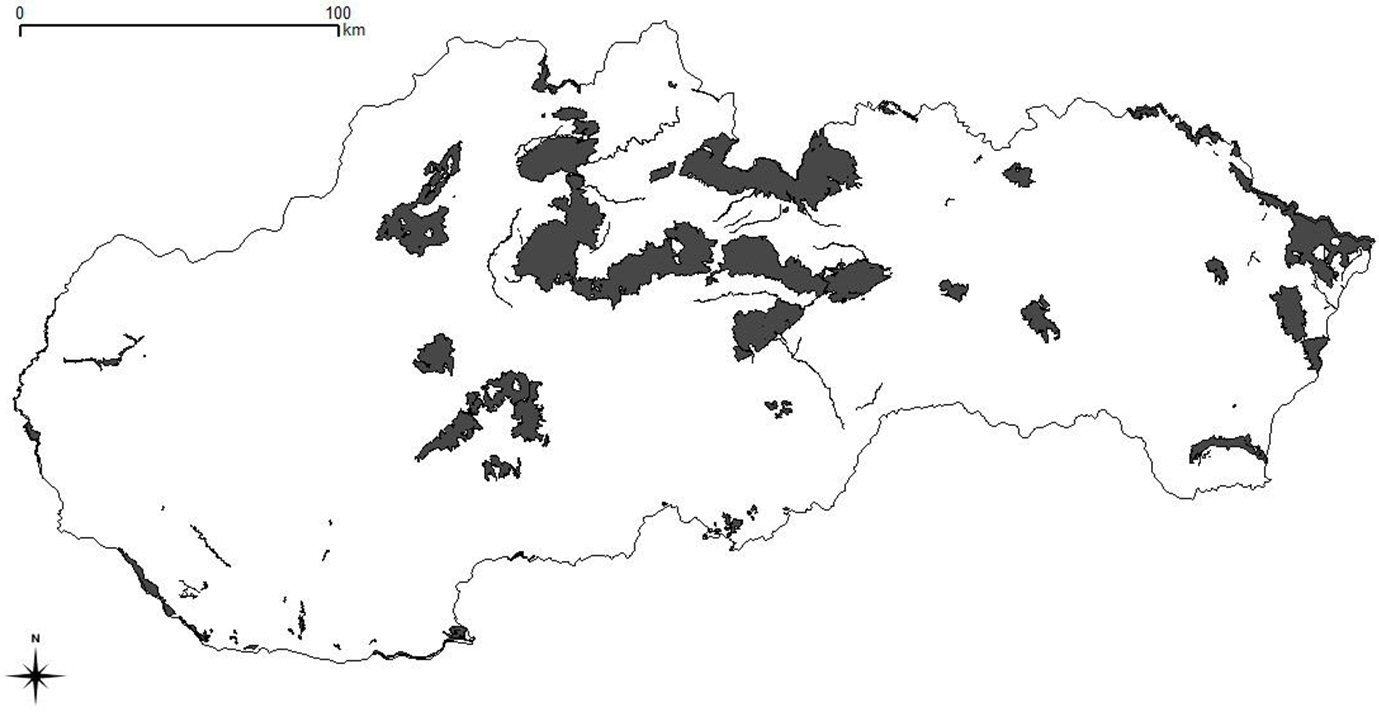
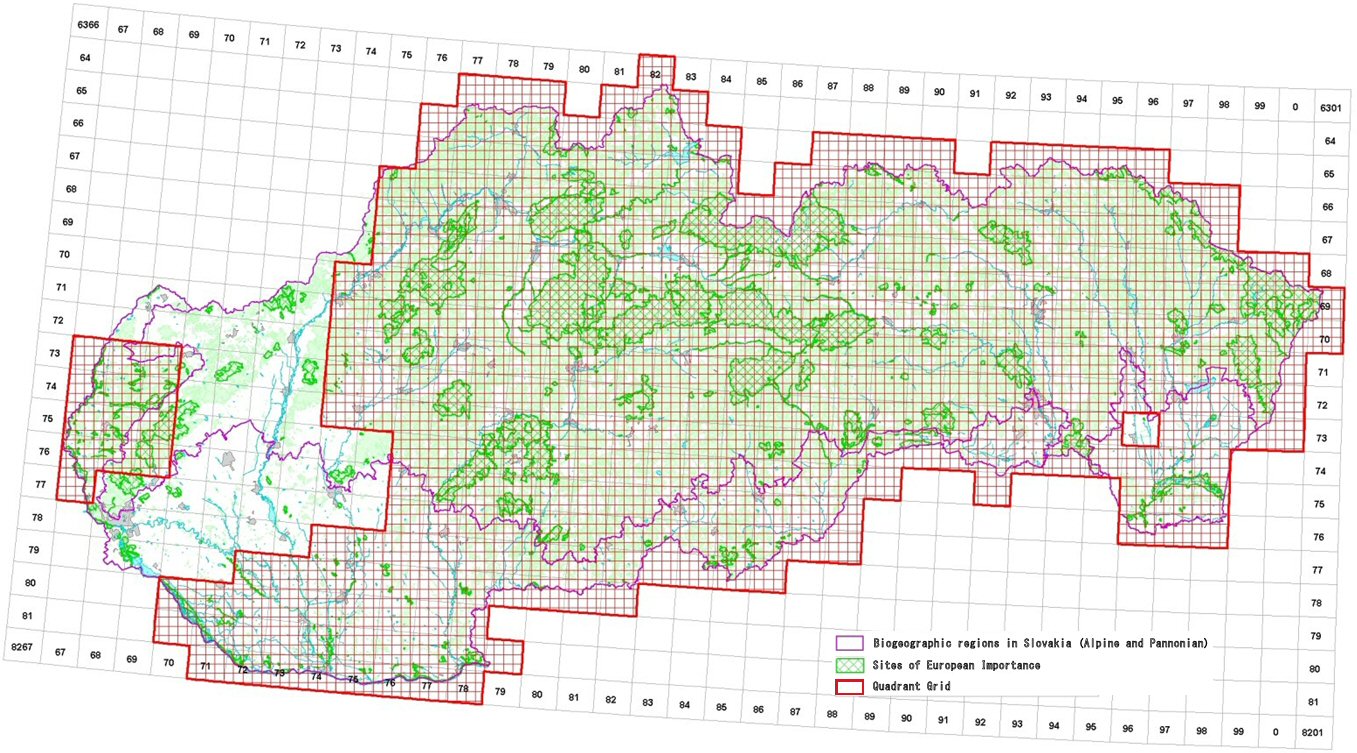
The country-wide mapping of the otter was not achieved in the Slovak Republic until 2007. The range of otter distribution was only determined in some regions or river basins. The first one-off otter mapping in Slovakia (in 275 quadrates, i.e. 64.1% from 429 DFS quadrates) was done in winter 2007/2008. The next mapping was carried out in winter 2008/2009 with aims: to gain objective information on otter distribution in some selected quadrates in which the mapping was not realized before, or in 1 quadrate (6780) with negative results during the first mapping. Results were obtained from 54 DFS quadrates (12.6% out of 429 quadrates) (Urban et al., 2010b). The third one-off otter mapping on the whole Slovak territory (in all 429 quadrates) was carried out from in summer and Autumn 2010.
There are two gaps in the mapping grid. In 2007/8, we were unable to map the upper streams of the Topľa, Ondava and Laborec rivers and in the middle part of the Váh, Nitra, Morava and Malý Dunaj river basins in the eastern part of the country due to financial and manpower constraints during the change in status of the State Nature Conservancy of the Slovak republic (SNC SR). In 2010, we did not map a western area (the Podunajská nížina lowland, and Trnavská pahorkatina Hills) because the environment here is so affected by the construction of water power plants, dams, water supply reservoirs, canalisation and other river reclamations, irrigation, pumping of ground water, and overall river basin management affecting water retention and acceleration of runoff which all mean otters are not present. There is also a small area in eastern Slovakia where this is true: the the urban and industrial complex of the city of Košice - otters are, however, present above and below this area on the river Hornád.
The aim of this paper is to summarize the knowledge on the otter distribution in Slovakia.
METHODS
The mapping was carried out from June 2010 to October 2010 with the so-called “standard” IUCN/OSG method for otter population monitoring– searching for signs of presence of the otter (footprints, anal gland secretions, spraints) in a network of UTM-grid quadrates (Reuther et al., 2000). The Databank of Slovak Fauna (DFS) grid (approx. 10x12 km) was used as a reference. In each of the quadrates we checked 4 –6 localities (600 m long river sections visited) for potential otter occurrence, but a survey was usually stopped as soon as the otter signs were found (Urban and Adamec, 2007). Spraints were rated in three categories – fresh (max. up to 5 days); medium (dry but yet, ca 6–14 days) and the old ones (dry, several weeks old, compact or chopped to some components) (Bas et al., 1984, modified by Urban and Topercer, 2001). During each check every spraint discovered was removed. Results were obtained from all 429 DFS quadrates in Slovakia.
RESULTS AND DISCUSSION
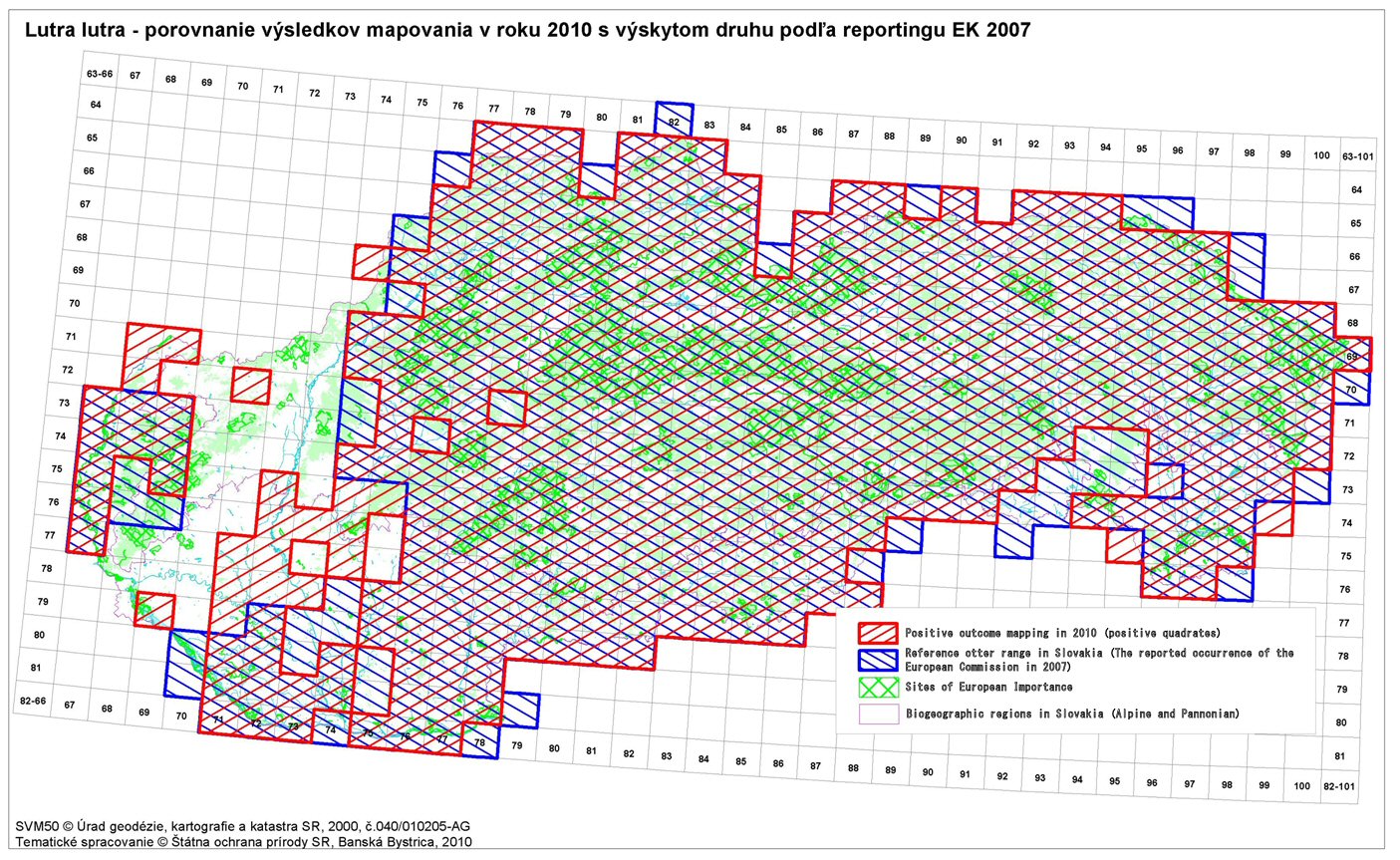
During the third survey of its distribution in the Slovak Republic, 349 quadrates (81,4%) of all 429 DFS quadrates were positive and 80 quadrates were negative (Figure 3). So we found that the Eurasian otter (Lutra lutra) occurs in most parts of the Slovakia with the exception of parts of the Western and South-Eastern lowlands of the country.
During both surveys of otter distribution 328 DFS quadrates (76.5% out of all 429 quadrates in the Slovak Republic) were checked in winters 2007/2008 and 2008/2009. A total of 292 quadrates (88.7% out of the checked quadrates; 61% out of all 429 quadrates in the Slovak Republic) were positive and 36 quadrates (1% and 8%, respectively) were negative (Urban et al., 2010b) (Figure 4).
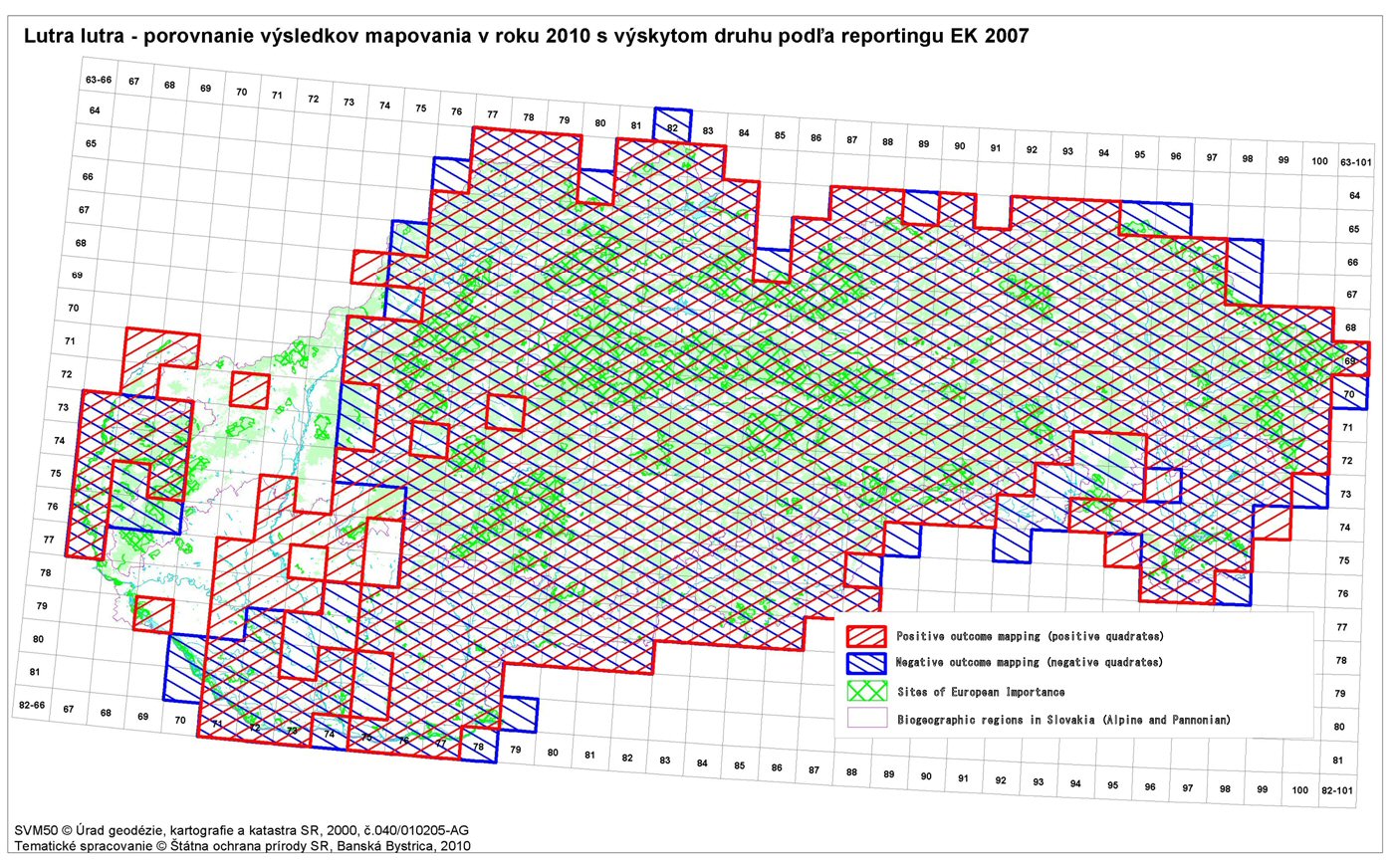
The otter occurs in most parts of Slovakia with the exception of parts of the Western and South-Eastern lowlands of the country. Its signs were found in all types of water bodies, including large (length over 200 km) and medium-sized (50.1 – 200 km) rivers, streams (10.1–50 km), rivulets (length up to 10 km), and channels of all sizes and in lakes and different types of artificial reservoirs and still waters (dams, ponds, fishponds) in various land cover classes.
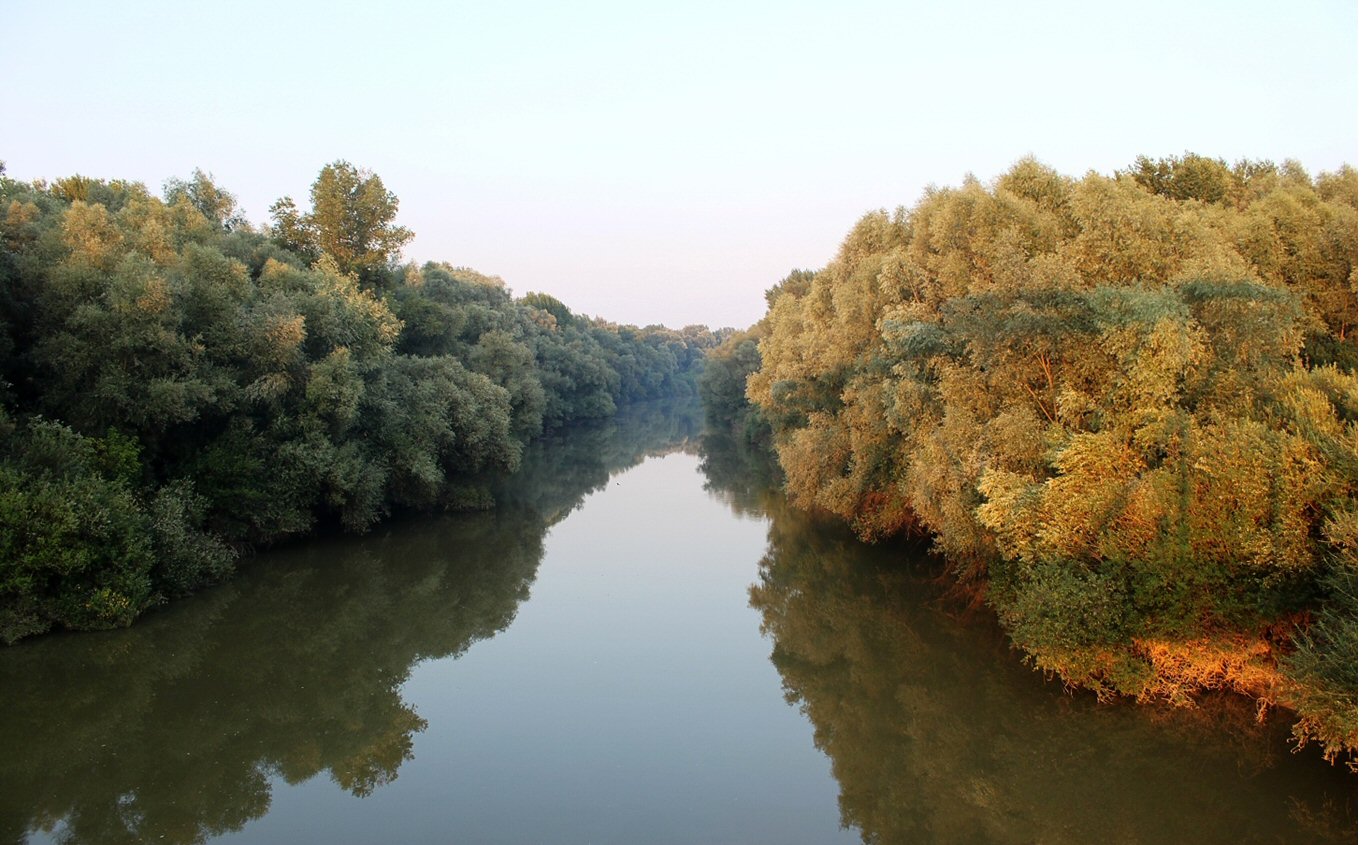
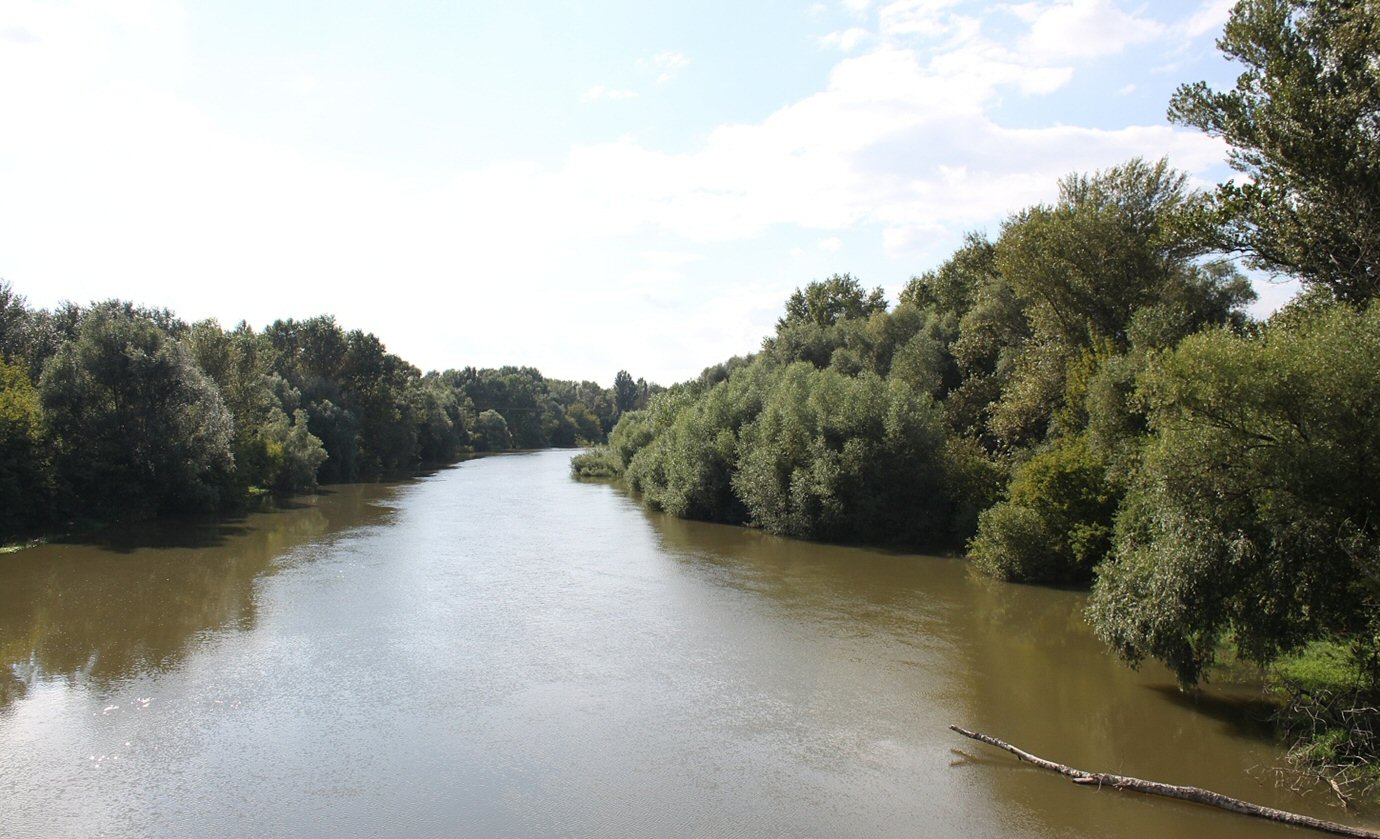
The species is more common along sub-mountain rivers of Central, Northern and North-Eastern Slovakia and their tributaries. Otters are missing in some parts of the lowlands and uplands of Western and South-Eastern Slovakia. The vertical distribution reaches from the lowlands to high mountains. The lowest observed altitude of occurrence was in the Východoslovenská nížina lowland, the localities Bodrog near Streda nad Bodrogom (100 m a.s.l.) (Figure 5), Boťany, Latorica (100 m a.s.l.), Somotor, Óbodrog or Zompod (100 m a.s.l.), from banks of the Danube River in the stretch between Gabčíkovo and Štúrovo, the localities Kamenica nad Hronom (103 m a.s.l.) (Figure 6) and Klížska Nemá (115 m a.s.l.); as well as from the downstream stretches of the rivers Váh, Nitra and Hron and from several drainage canals in the Podunajská nížina lowland. The highest altitudes of occurrence in Slovakia were recorded in Nízke Tatry Mts., Západné Tatry Mts., Vysoké Tatry Mts. and BelianskeTatry Mts. The otter is regularly observed in the upstream stretches of water bodies, such as the Vajskovský potok brook, locality Pálenice (1,080 m a.s.l.) (Figure 7) and some alpine lakes, for example Ťatliakovo Pleso Lake (1,360 m a.s.l.) (Figure 8), where it mostly occurs in spring. From the High Tatras, Profus (1999) mentioned an otter crossing over a mountain saddle at an altitude of 1,800 m a.s.l. The otter is an inhabitant of streams, wetlands and lakes, and also their bankside vegetation, where it finds a sufficient food supply the whole year round. In the lowlands of Podunajská nížina, Borská nížina and Východoslovenská nížina, it also inhabits artificial canals that offer sufficient food resources and high herbaceous vegetation providing shelter. Limiting factors for the otter occurrence are sufficient food supply, the amount of water in streams, fluctuation of discharges and the periodic drying up of streams with low discharge and availability of cover and shelters. Large reservoirs or dams with unsuitable littoral zones, fluctuating water table and subterranean outlets are unfavourable..


As the availability of water represents the main ecological factor affecting otter occurrence (Beja, 1992; Prenda et al., 1996, 2001; Bo Madsen and Prang, 2001; Bonesi and MacDonald, 2004; Kruuk, 2006), the model was developed on those river stretches that were likely to have water all year round. The Eurasian otter (Lutra lutra) occurs in a variety of habitats (Kruuk, 2006) that can be divided into two groups: - permanent (used throughout the year) and temporary (used for restricted periods) (Georgiev, 2005).
Other studies have revealed a positive influence of more wooded land for otter presence (e. g. Lodé, 1993; Baranauskas and Mickevičius, 1995). In Hungary, Kemenes and Demeter (1995) found a positive effect for land cultivation around aquatic habitats. Otters inhabited all of the studied stagnant waters but occurred more rarely in smaller streams (76%) (Lanszki, 2009).
There are a few European countries with otter populations which have no significant land that is higher than 1 000 m above sea level (a.s.l.) (e.g. Norway, France, Slovakia, Slovenia, Croatia, Bosnia, Yugoslavia, Greece, Bulgaria, Rumania andSpain) (Ruiz-Olmo, 1998).
CONCLUSIONS
During the mapping in summer 2010, 349 quadrates (81,4%) of all 429 DFS quadrates were positive and 80 quadrates were negative. The otter occurs in most parts of the Slovakia, especially along sub-montane rivers (large and medium-sized), rivulets and streams and their tributaries in Central, Northern and North-Eastern parts of the country . Most signs of the presence of the otter were found in sections of streams that raced through broad-leaved forests, coniferous forests, mixed forest and pastures with riparian vegetation in highlands, uplands and basin hill lands.
Acknowledgements - I would like to thank to many colleagues: Michal Adamec, Peter Bitušík, Bedřich Hájek, Petra Hájková, Ján Kadlečík, Andrej Saxa, Marianna Rajská, Erika Urbanová and students Gabriela Dunajská and Jozef Mihalčák for their assistance with fieldwork. I thank to all participants in the previous mapping. I also thank to Peter Pastorek for preparation of maps and Ľubomír Repiský for corrections of the map. The project was supported by the Vega grant No.1/0836/08.
REFERENCES
Baranauskas, K., Mickevičius, E. (1995) Some factors influencing the habitat use by otter (Lutra lutra) in Vilnius region. Ekologija 2, 49-53.
Bas, N., Jenkins, D. and Rothery, P. (1984) Ecology of otters in northern Scotland. The distribution of otter (Lutra lutra) faeces in relation to bankside vegetation on the river Dee in summer 1981. Journal of Applied Ecology 21(2), 507-513.
Beja P.R. (1992) Effects of freshwater availability on the summer distribution of otters Lutra lutra on the southwest coast of Portugal. Ecography 15, 273-278
Bonesi, L., Macdonald, D.W. (2004) Differential habitat use promotes sustainable coexistence between the specialist otter and the generalist mink. Oikos 106, 509-519.
Chanin P. (2003) Ecology of the European Otter.Conserving Natura 2000 Rivers Ecology Series No. 10. English Nature, Peterborough, pp. 64.
Conroy, J.W.H., Chanin, P.R.F. (2000) The status of the Eurasian otter (Lutra lutra) in Europe. A Review. In: Conroy, J.W.H., Yoxon, P., Gutleb, A.C. (eds). 2001. Proceedings of the First Otter Toxicology Conference. Isle of Skye, September 2000. International Otter Survival Fund, Broadford, Skye; Journal of the International Otter Survival Fund 1: pp. 7-28.
Conroy, J.W.H., Chanin, P.R.F. (2002) The status of the Eurasian otter (Lutra lutra). IUCN OSG Bull. 19A: 24-48.
Georgiev, D. (2005) Habitats of the otter (Lutra lutra L.) in some regions of Southern Bulgaria. IUCN OSG Bull. 22 ,6-13.
Hell, P., Cimbal, D. (1978) Rozšírenie a početnosť vydry riečnej (Lutra lutra L.) na Slovensku. Folia venatoria 8, 223-236.
Kemenes, I., Demeter, A. (1995) A predictive model of the effect of environmental factors on the occurrence of otters (Lutra lutra L.) in Hungary. Hystrix 7(1-2), 209-218.
Kranz, A. (2000) Otters (Lutra lutra) increasing in Central Europe: from the threat of extinction to locally perceived overpopulation? Mammalia 64, 357-368.
Kruuk, H. (2006) Otters: ecology, behaviour and conservation. Oxford University Press. Oxford, pp. 265.
Lanszki, J. (2009) Vadon élő vidrák Magyarországon. Natura Somogyiensis 1, 1-237.
Lodé, Th. (1993) The decline of otter Lutra lutra populations in the region of the Pays de Loire, Western France. Biological Conservation 65, 9-13.
Macdonald, S.M., Mason, C.F. (1990) Action Plan for European Otters. In: Foster-Turley, P., Macdonald, S., Mason, CF. Otters. An Action Plan for their Conservation. IUCN, Gland, 29-40.
Madsen, A.B., Prang, A. (2001). Habitat factors and the presence or absence of otters Lutra lutra in Denmark. Acta Theriologica 46(2), 171-179.
Mason, C.F., Macdonald, S.M. (1986) Otters, ecology and conservation. Cambridge University Press, pp. 236.
Mason, C.F., Macdonald, S.M. (2004) Growth in otter (Lutra lutra) populations in the UK as shown by long-term monitoring. Ambio 33, 148-152.
Poledník, L., Poledníková, K., Beran, V., Thelenová, J., Valášek, M., Prášek, V., Škorpíková, V., Dostál, M. (2008) Distribution of the Eurasian otter (Lutra lutra) in the Republic of Macedonia in 2007. IUCN OSG Bull. 25(2), 77-83.
Prenda, J., Granado-Lorencio, C. (1996). The relative influence of riparian habitat structure and fish availability on otter Lutra lutra L: sprainting activity in a small Mediterranean catchment. Biological Conservation 76(1), 9–15.
Prenda, J., Lopez-Nieves, P., Bravo, R. (2001) Conservation of otter (Lutra lutra) in a Mediterranean area: the importance of habitat quality and temporal variation in water availability. Aquatic Conservation: Marine and Freshwater Ecosystems 11, 343–355.
Profus, P. (1996) Ssaki. In: Mirek Z. (ed). Przyroda Tatrzańskiego Parku Narodowego. Wyd. TPN, Zakopane-Kraków, 435-454.
Reuther, C., Dolch, D., Green, R., Jahrl, J., Jefferies, D., Krekemeyer, A., Kucerova, M., Madsen, A. B., Romanowski, J., Roche, K., Ruiz-Olmo, J., Teubner, J. and Trinidae, A. (2000) Surveying and monitoring distribution and population trends of the European otter (Lutra lutra). Habitat 12, 1-148.
Ruiz-Olmo, J. (1998) Influence of altitude on the distribution, abundance and ecology of the otter (Lutra lutra). Symposia of the Zoological Society of London 71, 159-178.
Ruiz-Olmo, J., Loy, A., Cianfrani, C., Yoxon, P., Yoxon, G., de Silva, P.K., Roos, A., Bisther, M., Hájková, P., Zemanová, B. (2008). Lutra lutra. In: IUCN 2009. IUCN Red List of Threatened Species. Version 2009.1. <www.iucnredlist.org> Downloaded on 20 September 2010.
Urban, P., Adamec, M. (2007) Mapovanie vydry riečnej (Lutra lutra L.) na Slovensku. Chránené územia Slovenska 73, 23–24.
Urban, P., Topercer, J. (2001) Kznačkovaciemu správaniu vydry riečnej (Lutra lutra L.) na strednom Slovensku. Folia venatoria 30–31, 207-224.
Urban, P., Kadlečík, J., Topercer, J. and Kadlečíková, Z. (2010a) Eurasian otter (Lutra lutra L.) in Slovakia. Distribution, biology, risks and conservation. Faculty of Natural Sciences, Matthias Belius University, Banská Bystrica, pp. 128.
Urban, P., Urbanová, E., Adamec, M., Saxa, A. (2010b) Results of two Slovak national mappings of the Eurasian otter (Lutra lutra) in Slovakia. Ochrana prírody 26: (in press.).
Žiak, D., Urban, P. (2001) Červený (ekosozologický) zoznam cicavcov (Mammalia) Slovenska. Ochrana prírody 20(Suppl.), 154–156.
Résumé : La Loutre d’Europe (Lutra lutra) en Slovaquie – Rapport Preliminaire issu d’Enquêtes Nationales
La première enquête nationale sur la distribution de la Loutre en Slovaquie a été réalisée durant l’hiver 2007/2008. La cartographie a été élaborée à partir de la méthodologie légèrement modifiée du Groupe des Spécialistes loutres (OSG) de l’UICN. Les résultats ont été obtenus sur 275 cadrans issus de la Base de la Faune Slovaque (DSF) soit 64% des 429 cadrans existants. La seconde cartographie découle de l’enquête menée durant l’hiver 2008/2009 sur 54 cadrans (12.6 % des 429 cadrans). Pour ces deux enquêtes, la Loutre est présente sur 292 cadrans (88.7% des cadrans enquêtés; 61% des 429 cadrans de République slovaque) tandis que sur 36 autres elle est considérée absente (respectivement 1% et 8%). La dernière enquête sur l’ensemble du territoire slovaque (sur les 429 cadrans) a été menée l’été 2010 à partir de la méthode standardisée de l’UICN. Il en découle 349 cadrans positifs (81.4%) et 80 négatifs (18.7%).
La Loutre est présente sur la majeure partie du territoire slovaque à l’exception des plaines de l’ouest et du sud-est du pays. Les indices ont été trouvés sur tous types de cours d’eau, des canaux de toutes tailles, des réservoirs de toutes sortes (lacs, étangs, étangs de pêche) et dans des habitats variés.
Revenez au dessus
Resumen: La Nutria Euroasiatica (Lutra lutra) en Eslovaquia: Reporte Preliminar de un Censo
El primer censo nacional de distribución de nutria en Eslovaquia fue realizado en el inviernos 2007/2008. El trazado fue llevado a cabo utilizando estándares modificados de la metodología IUCN/OSG. Resultados fueron obtenidos de 275 (64%) de lo 429 cuadrantes del Banco de Datos de Fauna Eslovaca (Databank of Slovak Fauna (DSF)). El segundo trazado fue llevado a cabo en el invierno 2008/2009 en 54 cuadrantes DSF (12.6%). En ambos, la nutria se encontró presente en un total de 292 cuadrantes (88.7% del total de cuadrantes censados y 61% del total de cuadrantes en la República de Eslovaquia); mientras que no se encontró presente en 36 de los cuadrantes censados (1% y 8% respectivamente). El tercer censo en todo el territorio eslovaquia (todos los 492 cuadrantes) fue llevado a cabo en el verano del 2010 con el método “standard”. Se encontraron 349 cuadrantes (81.4%) positivos y 80 cuadrantes (18.7%) negativos.
La nutria se encuentra presente en la mayor parte el país con excepción de algunas tierras bajas en el oeste y el sudeste. Sus marcas fueron encontradas en todo tipo de cuerpos de agua y canales de todos los tamaños. Así como en diferentes tipos de reservorios (presas y estanques) con diversas coberturas y usos de suelo.
Vuelva a la tapa