IUCN/SSC Otter Specialist Group Bulletin

|
©IUCN/SCC Otter Specialist Group Volume 28 Issue 1 Pages 1- 60 (January 2011) Citation: Morales-Betancourt, D. (2011). Report of an Adaptive Reintroduction of a Juvenile Giant Otter (Pteronura brasiliensis). IUCN Otter Spec. Group Bull. 28 (1): 23 - 33 Report of an Adaptive Reintroduction of a Juvenile Giant Otter (Pteronura brasiliensis) Diana Morales-Betancourt1 1Volunteer Researcher. Omacha Foundation Calle 86A No. 23 - 38. Barrio El Polo - Bogotá D.C., Colombia. (dianamoralesb@yahoo.com) |
 |
| Abstract: Adaptive programs based on soft release and individual behavior changes may increase the survival rate of reintroduced giant otters (Pteronura brasiliensis). Key components of the program include the development of temporary enclosures and refuges, implementation of a responsive feeding program, an environmental adaptation program, as well as the use of a registered vocal repertoire and behavior information. This study was conducted by the Omacha Foundation, from March to June in 2008 in the Colombian Orinoco Ecorregion. The entire process occurred over 74 days, with 54 spent evaluating the animal, and the following 20 days spent implementing an intensive adaptive reintroduction program. The juvenile otter was successfully reintroduced, as evidenced by its repeated sighting after 17 months. |
| Keywords: Pteronura brasiliensis, soft release, rehabilitation, animal behavior, vocal repertoire, otter diet. |
| Française | Español |
INTRODUCTION
The Giant otter (Pteronura brasiliensis) is an endemic mustelid of the lowland forest in South America. The species is globally categorized as Endangered (A3cd) by the International Union for Conservation of Nature – IUCN (Duplaix et al., 2008). It was in peril in the past mainly due to the direct hunting for its fur. Currently it is threatened by habitat loss, fragmentation and poaching (IUCN-OSG, 2007).
In Colombia a significant threat is the conflict between this species and fishermen, who consider the animal to be a competitor for fish resources. Other threats include unsustainable tourism, river contamination by oil spills in Arauca, and by mercury contamination in the Orinoco and Amazon rivers, overfishing exploitation at the Vichada Department, and capture and sale or trade as pets (Trujillo et al., 2006).
Often, when giant otters are taken as pets, the parents were killed in order to approach the cubs. However, other times parents are just hit to keep them away from the cubs. Afterwards, the cubs are sold or go to their captor’s home. The first months are the most exciting for the captors since otters are very playful animals, but as time goes on, the animal demands more food. Otters become more expensive and clever, as they can learn how to open the refrigerator, and often play more and more aggressively in response to interaction with humans, becoming a burden to the family (Morales-Betancourt, pers. observ.).
Other issues occur when captive otters are restricted to enclosures in the backyard and frequently play and interact with dogs and other domestic animals. Captors may decide to tie them up, leading to scratches that can cause infection and in many cases death (Morales-Betancourt, pers. obs.). In some cases the animals are handed over to Regional Environmental Authorities (known as CAR in Colombia). In other cases these institutions or the police confiscate the animals, as it is illegal to keep them as pets in Colombia (Decree 1608 in 1978 and Law 599 in 2000).
When the animal is at the CAR, it confronts three possible options: euthanasia, life in captivity in an ex situ conservation center or starting the rehabilitation process (IUCN, 2000). This last option is restricted to the areas where the environmental authorities have rehabilitation programs in place (Ministerio de Medio Ambiente, 2002), and only a few currently exist. More commonly, the CAR will give the animals to an organization that agrees to pursue a rehabilitation and reintroduction process. These organizations are mainly NGO’s, as is the case of the Omacha Foundation
The reintroduction process for otters can prove to be problematic. Few reintroductions have been documented for the giant otter and even fewer include any follow-up monitoring of animal survival, resulting in a high level of unknown success rates. (Gómez et al., 1999; Gómez, 2003; McTurk and Spelman, 2005).
At the Omacha Foundation, the reintroduction process begins after a suitable place is selected according to the species’ natural distribution range, previous research determining whether other otters are in the area, whether the area fulfills the species’ requirements such as nest sites and food availability through the year, the possible presence of competitors and potential natural and anthropogenic threats. The animal needs to be in optimal physical and health condition, as well as demonstrating appropriate behavioral responses. The reintroduction process is customized for each animal and does not stick to a rigid date schedule; it includes activities that habituate the animal to its surrounding area and motivate it to develop activities that ensure its survival in an adaptive process tailored to the behavior changes exhibited by the animal.
OBJECTIVEThe objective of the process was to design and implement an adaptive reintroduction program for the giant otter (Ptenorura brasiliensis).
To achieve this objective, four components were considered:
- developing temporary enclosures and a shelter;
- developing and implementing a progressive feeding program to transition the animal to hunting for itself;
- creating an environmental adaptation program; and
- recording vocal repertoire and behavior information, which fed into the components above to allow tailoring to the individual animal’s development.
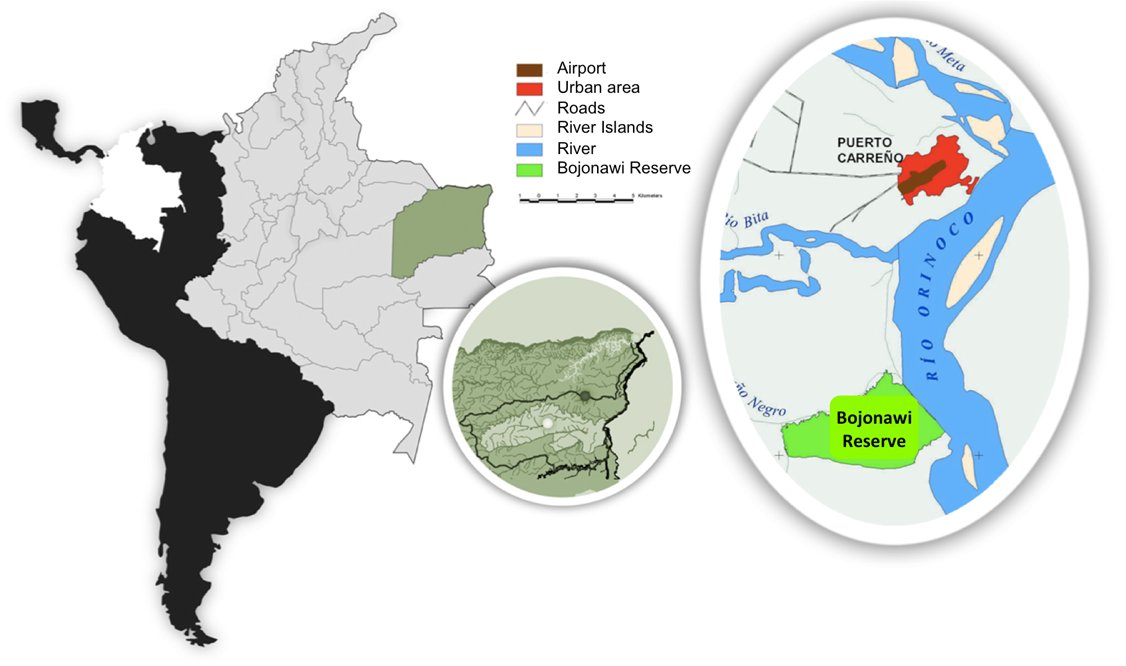
This process took place at the Bojonawi Private Natural Reserve, Eastern Colombia, which has a size of 4.682 ha. It is located in the Orinoco Ecoregion, in the Vichada Department by the border with Venezuela, next to the Orinoco River (Fig. 1). This area is part of the corridor in the El Tuparro World Biosphere Reserve.
The rainy season occurs here between April and November with an annual precipitation of 1700mm. During the rainy season, the temperature fluctuates between 35°C and 25°C and during the non-rainy season, temperatures vary between 42°C and 32°C (IDEAM, 2008).
 |
|
Figure 1.
Location of the Bojonawi Reserve (Source: Omacha Foundation). (click for larger version) |
The area has one small lagoon “El Pañuelo” with riparian forest and Precambrian rock formations, two creeks that flow to the Orinoco River. El Pañuelo during the flood season connects with the Orinoco River as well. A solitary otter, as well as a family of otters live in the lagoon (Morales-Betancourt, pers. obs.).
REINTRODUCTION PROGRAM
A sixth month old male giant otter was given to Omacha Foundation by the CAR (Regional Environmental Authority) “Corporinoquia” after remaining under their care for 25 days at their establishment in La Primavera (Vichada). The animal had already been imprinted. Information on the specimen provided from the CAR is shown in Table 1.
Program Components
1. Develop temporary enclosures and shelter
The enclosures were made using the natural materials available. The first one was built on land 300m away from existing infrastructures. The purpose was to keep the animal away from people at night. The second enclosure was built 500m away from the infrastructure area. Part of this enclosure included natural water from the lagoon and its purpose was to improve the animal’s hunting skills.
First Enclosure:
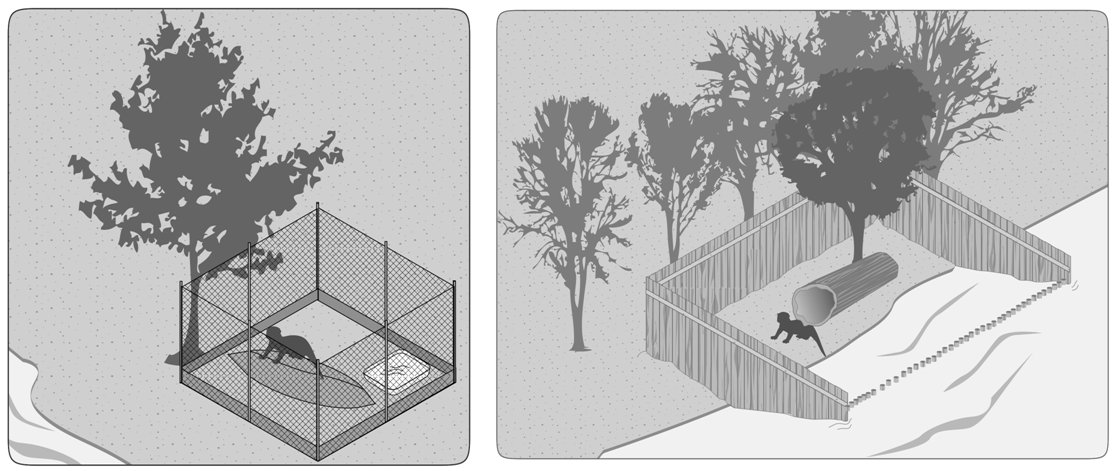
Total area was 6.25m2 with chain-link fencing supported by wood posts and a wooden ledge along the bottom to prevent the otter digging underneath. Inside the enclosure, there was one wooden shelter where the animal could sleep. There was also a 9 gallon plastic container for water (Fig. 2).
Second Enclosure:
Total area was 40m2 with chain-link fencing supported by wood posts at the ground surface and a wood fence reinforced with chain-link fencing on the outside of the aquatic area. The area contained a natural wood shelter, with other natural features and materials (fallen leaves, sprouting vegetation, a large tree). The fencing on the lagoon side ended a few centimeters above the water level to allow the otter to move freely between the aquatic enclosure and the surrounding lagoon area, whilst retaining live fish introduced into the enclosure water area (Fig. 2).
 |
| Figure 2.
Left: First enclosure; Right: Second enclosure (Source: Ochoa F.). (click for larger version) |
Shelter:
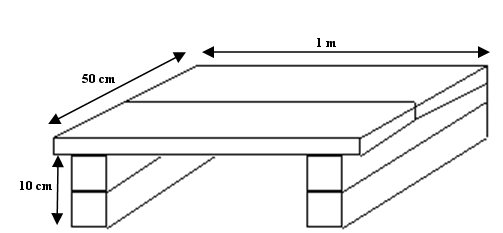
Two wooden planks 1m in length and 25cm wide were placed to form a roof on two supports each consisting of two square-cut timbers measuring 5x5cm and 50cm long laid on their sides, one on top of the other (Fig. 3) to make a night shelter for the otter outside the fence close to the riparian area of the lagoon. The purpose was to provide shelter from environmental conditions, and potentially from other animals, while also providing the otter with the opportunity to move about and explore 24 hours a day. At first the otter did not use the shelter, but as he explored more of his environment, he started to use it.
 |
| Figure 3.
Shelter diagram, showing the arrangement of the timbers |
2. Implement feeding program
The Omacha Foundation evaluated the feeding behavior of the animal by first testing his capabilities with little pieces of fresh fish when he arrived at the Reserve. From this, it was possible to determine if the animal was able to eat whole fish.
Feeding sessions ran from 6:30h to 17:00h, with feeds every two hours. The animal was always fed in the water, and at first was fed close to the bank outside any enclosure, because he was not used to the water and his swimming and hunting skills were undeveloped.
The main parameters observed were about the otter´s swimming and catching skills, and included the ability of the otter to find and eat the freshly killed fish provided underwater by thrown or placed on the shore by the researcher. At first he was fed next to the bank in less than 20cm of water with freshly killed fishes. At all times, the fish were always visible to the otter (i.e. not concealed in any way, and the water was clear), and feeding alternated between live fish given in a plastic container and freshly killed fish. A selection of the fish species available in the area was provided. To measure the amount of fish needed to adequately feed the otter, fish were provided until the otter only ate the heads of the fish, at which point it was assumed he had eaten enough to satisfy his appetite. Additionally, to allow for personal feeding preferences, if a new species was provided and the otter did not eat the entire fish, another of a familiar species was given to ensure that he ate enough food in total to be no longer hungry.
From the 11th day, the time between feeding sessions increased to three hours, with live fish provided at the bank as well as fish that were struck on the head and thrown 1m from the bank. The otter vocalized more at the first feed of the day, especially when this was of live fish. The first enclosure with the plastic container was no longer used. By now, the animal was swimming freely in the lagoon, using different areas and moving frequently from shore to bank. Because of this, we began to use a new feeding zone in the lagoon and used this once per day. The site was located close to the emergent woody vegetation that the otter utilized for eating. The second enclosure was also used as a location to provide some live fish, in order to restrict the possibility of the fishes escaping.
Species provided came from fishing conducted daily in the early morning, with the most frequently given fish including “palometa” (Mylossoma duriventris), “arenca” (Triportheus angulatus), “chorrosco” (Pimelodus blochii) and “platanote” (Laemolyta taeniata). Even though some “sierra” (Oxydoras niger) and “cucharros” (Hemisorubim platyrhynchos), were given, the otter did not eat them, possibly due to the hard structures of the species (Table 2).
After nine days of this new feeding routine, the animal dramatically reduced contact with the researcher and more fish were left in the second enclosure to avoid unnecessary contact with the researcher for food. The otter’s catching skills improved significantly, and by this time, the animal was catching more than 90% of the live fish provided to him at greater than 4m depth in the lagoon area.
In the last three days of the process, the otter received one fish each day in the early morning, the researcher approached the area where the otter was sleeping using a canoe, the otter approached the researcher and then fish were thrown, but no additional contact was made during the day.
No fish were provided after the 28th day. The second enclosure was kept available until it flooded for a further 15 additional days, in case the otter wanted to go back, and live fish were provided in it available for hunting.
The average weight of fish eaten per day during the process was 1.8 kg. The animal had increased in weight by 4.1kg since the confiscation; 16 days after the program started the otter weighed 9.3kg at an approximate age of 8 months.
3. Recording Behavior
Observation of the otter’s behavior was done from May 30th through June 17th , after 54 days at Bojowani; 515 records were made, 318 in the morning and 195 in the afternoon. Of these records, 39.22% were related exclusively to water activities, 40.19% to activities on the ground or rock surfaces, and 19.22% to activities on the shore and emergant woody vegetation.
The observations were made at 21 different points inside the reserve.
Categorization of behavior was done using Duplaix (1980) as a reference, with some regrouping and creation of two new categories: request for food and escape.
- Aquatic Locomotion: swimming (including diving)
- Terrestrial Locomotion: walking, trotting, galloping
- Feeding: including hunting activity
- Grooming: including rubbing, fur nibbling and scratching
- Resting: only in the daytime, including yawning
- Playing: with seeds, fruits, branches, and other objects
- Alarm: after a noise or animal passing by: periscope, jump, straight head and body (not related with searching)
- Elimination: defecation and urination
- Agonistic: where inter or intraspecific encounters are avoided, sometimes with side movement of the head (left-right and right-left) with vocalizations
- Searching: olfactory and visual search with paused locomotion, sometimes approaching animals or objects
- Affiliative: searching for or keeping contact with family members (in this case with the researcher)
- Request for food: the animal approaches the researcher to smell her mouth, insistently also making vocalizations.
- Escape: climbing or digging close to the fence, trying to get out.
Vocal Repertoire
All sounds were recorded with video, and annotations were made regarding the context, followed by typing and categorization.
Categorization was based on Staib (2005) and Duplaix (1980); their categorizations are related to behavior between the animals and their age. One of the categorizations was difficult to use: we found we hand to group screams and whistling into a group named “calls”. The following categories were used: contact murmur or hum, growl, warning or snort, HAH, and the “comfort” category. This additional category was created because the previous categorizations did not have a similar sound description. This sound is made prior to the animal sleeping, when it is already in a comfortable position. It appears as though the otter is imitating a suckling movement with the mouth and makes a corresponding specific sound.
Two non-vocal sounds were also reported: hiccup and yawn, and there were no reports for other non-vocal sounds like sneeze and cough that Duplaix (1980) reported.
Analysis of the behavior, location of occurrence and vocalization were made in order to modify the adaptation program appropriately to the behavioral development of the animal.
4. Environmental adaptation program
This program includes exploration, recognition and adaptation activities. It started after 54 days at the Bojonawi Reserve with the otter living in the first enclosure during the assessment phase. Once the environmental adaptation program began, vocalization and behavior information was recorded following ad libitum methodology. The adaptation activities were designed to allow the animal to learn to relate to the wild environment.
Exploration activities were made by the otter walking and swimming along the shore of the lagoon and flooding channels, which are natural routes for the species in this location. As the water started to rise during the flooding season, a canoe was used more often by the researcher, leading the otter who swam alongside. Focus areas were otter latrine spots and dens that were not in use at that time. Specific direct interactions with other species were encouraged on a few occasions, including swimming in the “Charapa” pond, a very small pond containing turtles (Podocnemis expansa), located in the flooded savanna where water clarity is very high and fish can be easily seen underwater. Another example was a small creek “Caño verde” that is used by the other giant otters in the rainy season as a natural corridor.
Recognition activities consisted of going back to previously explored sites and taking more time to carefully explore. Adaptation activities included the otter establishing campsites on the shore of the lagoon where he was able to go into the water to play and swim, eat at the shore, and rest, groom, and sleep on the upper rocky area. Close to the campsite the otter established a latrine spot. The adaptation activities in total usually lasted for a period of about five hours in the morning and three hours in the afternoon. The otter initially established two campsites by the lagoon, but after the third day, he avoided that site, therefore a new campsite close to the forest and other wild otters was chosen. This program encouraged the otter to use the water a lot because he did not have very much experience of swimming before the program started.
Evolution of the process
At the beginning the animal remained close to the researcher and did not swim underwater; he was constantly seeking eye contact, constantly returning to the bank or getting into the canoe. On the third day, the animal became interested in exploring the shore of the lagoon in the flooded forest, finding seeds, and following fish. After three weeks the animal was going into the lagoon by himself without the researcher encouraging him to do so; the otter was also going to deeper water, swimming for longer periods underwater, and increasing his speed. Some minor amounts of terrestrial exploration activities were made, and were focused on the natural seasonal paths of the species in the area. During periods of rainfall, the animal remained in the water and was seen to be able to stay there for four hours.
On the ninth day, the otter made continued vocalization while searching in the flooded forest, where he encountered a group of five otters. The group of otters made snort sounds (Duplaix, 1980) and they moved away from each other. Following this, the otter in rehabilitation stayed in the forest without contacting the researcher for one hour. Without making any vocalizations, the otter then approached the researcher and the program continued. On the 13th day, the otter did not follow the researcher during the recognition swim through the lake, and instead swam back to the flooded forest area of the lagoon. Later that day and on the 14th day new contacts were made with other otters, but due to the water levels rising in flood, it was impossible for the researcher to determine if it was the previous group contacted or the solitary individual; several vocalizations were heard before and after the contacts.
During the adaptation activity on this day, the otter swam 15m away from the shore, which is a sign of improved swimming ability and confidence in moving though the aquatic area. That night, the otter used the shelter for the first time. On the morning of the 16th day and the afternoon of the 17th, we considered that the exploration part of the program was complete, because the otter’s behavior was changing and it was evident that contact from the otter might finish at any time.
On the 18th day during the afternoon, a solitary otter approached the campsite from the lagoon making “HAH!” vocalizations (Duplaix, 1980). The otter in the rehabilitation program was resting, however, and did not seem to notice the presence of the other otter. From the 18th day onward, the otter stayed in the forest by his own choice and slept in the other shore that was frequently used for the adaptation process. On the 19th day, after eating one fish provided by the researcher from the canoe and close to his new campsite, the otter followed the researcher through the lagoon, but then went back by himself. One hour later, the otter joined the researcher at the campsite and stayed there for a couple of hours. At noon he left again and returned one hour later; a couple of live fishes were provided, but while he did not catch the first two, he caught and ate the third fish. He played in the area and slept in the forest again in the same place. The next day in the early morning, he received two fishes in the water, which he caught quickly and ate. After he swam back to the area where he slept, he was not seen for the following seven days.
At this point, we considered that the rehabilitation program had ended as the otter had self-released back into the environment.
A photo showing the neck pattern was distributed to the researchers and local assistants in the reserve, in order to track sightings of this individual. After four months, the otter was sighted again and a few sightings even occurred 17 months later. Multiple staff members had reported the sightings, including the researcher that carried out the rehabilitation process.
CONCLUSIONS- As individual captive otters may have different skills and relationships with the natural environment, individualized adaptive programs may be a way to increase the rate of successful reintroductions of the giant otter in appropriate areas.
- Feeding programs need to be a key component of the rehabilitation process, with a focus on developing catching skills in conjunction with the environmental adaptation program.
- Behavioral changes will give insights to the researcher as to an appropriate timeline and pace for the different components of the process.
- Some species that are part of the natural diet of other otters in the area were not consumed by this individual. This could be due to the wide availability of fish species, allowing him to develop certain preferences instead of eating the first available option.
- Other food resources such as small reptiles were not provided. This may reduce the future preferences of the otter for this type of food in the wild.
- Enclosures to enhance fishing skills proved to be a good complementary method to develop hunting capabilities.
- Shelters are needed for animals that are not used to being exposed to different climatic conditions, especially during the rainy season.
- Continued documentation of these types of program with other individuals is necessary to determine if there are increased survivals rates for reintroduced otters prepared using this kind of approach
- Because otters are territorial animals, sufficient area with appropriate conditions is required for future program development and expansion in the region; there must be enough space for the introduced otter to avoid the residents if necessary
- Although affiliation behavior was recorded between the otter and the researcher, it did not seem to create a barrier to the reintroduction process in this case.
- It is important to develop research investigation motivations, history and current status of the propensity of the public to have giant otters as pets, in order to better understand this trend and estimate the threat this poses to the species.
Acknowledgements - I thank Arno Gutleb, Shayna Brause, Michele Bratschun and Fredy Ochoa for their help and suggestions on this manuscript.
REFERENCES
Decrete (Decree) 1608 de 1978 (julio 31). Reglamenta el Código Nacional de los Recursos Naturales renovables y de Protección del Medio Ambiente y la Ley 23 de 1973 en materia de fauna silvestre. Diario Oficial, agosto 29 de 1978.
Duplaix, N., Waldemarin, H.F., Groenedijk, J., Evangelista, E., Munis, M., Valesco, M., Botello, J.C. (2008). Pteronura brasiliensis. In: IUCN 2010. IUCN Red List of Threatened Species.
Duplaix, N. (1980). Observations on the Ecology and Behavior of the Giant River Otter (Pteronura brasiliensis) in Suriname. Rev. Ecol. (Terre Vie), 34: 496-620
Gómez Serrano, J.R. (2003). Follow up to a rehabilitation of giant otter cubs in Colombia. IUCN Otter Spec. Group Bull. 20: 42-44.
Gómez, J. R., Jorgenson, J.P., Valbuena, R. (1999). Report on the rehabilitation and release of two giant river otter (Pteronura brasiliensis) pups in the Bita River (Vichada, Colombia). IUCN Otter Spec. Group Bull. 16: 86-89.
IDEAM (2008). Programa de Meteorología Aeronáutica.
[Available at: http://bart.ideam. gov.co/ Accessed 27 May 2011]
IUCN (2000). Guias para la disposicion de animales confiscados. Aprobadas en la 51a Reunión del consejo de la UICN, Gland, Suiza, Febrero del 2000. 25pp.
IUCN-OSG. (2007). Pteronura brasiliensis (Gmelin, 1788), the Giant Otter.
[Available at: http://www.otterspecialistgroup.org/Species/Pteronura_brasiliensis.html Accessed April 23, 2011]
Ley (Law) 599 de 2000. (julio 24). Codigo penal. Diario Oficial No 44.097 de 24 de julio del 2000.
McTurk, D., Spelman L. (2005). Hand-rearing and rehabilitation of orphaned wild giant otters, Pteronura brasiliensis, on the Rupununi river, Guyana, South America. Zoo Biology 24: 153-167.
Ministerio de Medio Ambiente, República de Colombia (2002). Centros Regionales para el Manejo de Especímenes de Fauna Silvestre Decomisados. Colombia. 51ppp.
Staib, E. (2005). Eco-Etología del lobo de río (Pteronura brasiliensis) en el sureste de Perú. Primera Edicion. Perú. 195pp.
Trujillo, F., Botello, J. C., Carrasquilla, M. C. (2006). Perro de agua Pteronura brasiliensis. In: Rodriguez-Mahecha, J.V., Alberico, M., Trujillo, F., Jorgeson, J. (eds.) Libro Rojo de los Mamíferos de Colombia. Conservación Internacional Colombia, Ministerio de Medio Ambiente, Vivienda y Desarrollo Territorial. 433 pp.
Résumé : Bilan de l’Adaptation d’une Jeune Loutre Geante (Pteronura brasiliensis) Suite à sa Reintroduction
Les programmes d'adaptation basés sur des relâchers adaptés et sur la variabilité des comportements individuels peuvent augmenter le taux de survie des loutres géantes réintroduites (Pteronura brasiliensis). Les éléments clés du programme comprennent la mise en place d’enclos et de refuges temporaires, la mise en œuvre d'un programme d'alimentation adapté, un programme d'adaptation à l'environnement, ainsi que l’enregistrement d'un répertoire vocal et de données comportementales. Cette étude a été menée par la Fondation Omacha, de Mars à Juin 2008 dans l’éco-région colombienne de l’Orénoque. L'ensemble du processus s'est déroulé sur 74 jours, avec 54 journées consacrées à l'évaluation de l'animal, et les 20 jours suivant alloués à la mise en œuvre du programme intensif d'adaptation à la réintroduction. La jeune loutre a été réintroduite avec succès comme en témoignent ses observation répétées durant 17 mois.
Revenez au dessus
Resumen: Reporte de una Reintroducción Adaptativa de un Individuo Juvenil de Nutria Gigante (Pteronura brasiliensis)
Las liberaciones suaves teniendo en cuenta el cambio de comportamiento en cada individuo puede ser el método para incrementar el porcentaje de éxito de la reintroducción de las nutrias gigantes (Pteronura brasiliensis) a la vida silvestre. En el presente estudio fue determinante incluir los siguientes componentes: desarrollo de encierros temporales y una madriguera, la implementación de un programa de alimentación acorde a la evolución del individuo en el programa de adaptación al ambiente, y adicionalmente realizar registros del repertorio vocal y del comportamiento. Este estudio fue realizado por la Fundación Omacha entre marzo y junio de 2008 en la ecorregión del Orinoco colombiano. El proceso duró en total 74 días de los cuales 54 fueron realizando cortas actividades para evaluar al individuo y los 20 días restantes realizando un intensivo programa de reintroducción adaptativo. El ejemplar fue reintroducido exitosamente ya que se continua observando incluso 17 meses después en el área.
Vuelva a la tapa