IUCN/SSC Otter Specialist Group Bulletin

|
©IUCN/SCC Otter Specialist Group Volume 28A Proceedings Xth International Otter Colloquium, Hwacheon, South Korea Citation: Evangelista, E. and Rosas, F.C.W., B. (2011) Breeding behavior of Giant otter (Pteronura brasiliensis) in the Xixuan Reserve, Roraima, Brazil . Proceedings of Xth International Otter Colloquium, IUCN Otter Spec. Group Bull. 28A: 5-10 Breeding behavior of Giant otter (Pteronura brasiliensis) in the Xixuan Reserve, Roraima, Brazil Emanuela Evangelista1, Fernando C.W. Rosas2
1
Associação Amazônia NGO, Caixa Postal 1212 Ag. Saldanha Marinho, Manaus - AM, 69080-710, Brazil (Phone: +55 (92) 92165584, mobile: +39 347 1375202 e-mail: eman_evan@hotmail.com |

 |
|
Abstract: A population of giant otters was studied in the central Brazilian Amazon at the Xixuaú Reserve, Roraima, in order to gather ecological and behavioral data. Through the period 2000-2003 14 litters were recorded, all concentrated in a few months (August-December) during the receding water and low water seasons. The reproductive peak seems to be connected to the food availability in the water river system. Litter size varied from 1 to 4 cubs with an average of 1.8 (n=12). It was confirmed that a strong positive correlation exists between group size and reproductive rate, although no evidence of the “baby-sitting” system described by other authors was found. The study supplies information on cub development and confirms that all the group members are involved in the cubs rearing. |
| Française | Español |
INTRODUCTION
The giant otter (Pteronura brasiliensis) is one of the world’s most endangered otter species. Nonetheless, information on the reproductive characteristics of the species is scanty and primarily derived from captive observation of few animals (Carter and Rosas, 1997). Giant otters live in groups that consist of a breeding pair (alpha couple) and its offspring; cubs reach sexual maturity at about 2 years old when usually leave the group and disperse. A number of authors have revealed that a degree of seasonality in breeding does exist in different habitats (Duplaix, 1980; Laidler, 1984; Rosas et al., 2004; McTurk and Spelman, 2005; Staib, 2005). The Xixuaú Reserve is a protected area of 178,000 ha, accessible exclusively by boat from the city of Manaus with a journey of approx. 500 km. The area is virtually uninhabited, with a human population density of 0.04 persons per km2. The resident population was studied in order to gather information on the breeding behavior of giant otters in a pristine area.
MATERIALS AND METHODS
The Xixuaú Reserve (0º48’S, 61º33’W; altitude 30m a.s.l.) is situated on the right hand bank of the Jauaperí River, which marks the border between the Brazilian states of Amazonas and Roraima. It consists mainly of primary tropical rainforest traversed by a black-water river and many creeks. The yearly rainfall is about 2,000 mm with a dry period from October to February. During the flooded season, the water level usually rises up to 10 m, flooding wide portions of the forest and sandy beaches along the watercourses.
Between October 2000 and March 2003, 14 months were spent in the study area in order to gather ecological and behavioral data on the giant otter population. The resident groups were followed and filmed by a camcorder and the individuals were recognized by their throat markings. The presence of cubs was registered and their age was estimated. When birth occurs in a known group the cub’s age can be established with few doubts. Otherwise the age was estimated according to the available information on physical and behavioral development of cubs. Age classes defined in Groenendijk (2005) have been adopted to describe the newborn as cub (up to 6 months old) or juveniles (between 6 months and 1 year of age). With the aim of studying the existence of a reproductive peak in the study area, births and water level variation were recorded, the latter measured daily.
RESULTS AND DISCUSSION
Breeding seasonality
During the study period, the births of 14 litters were recorded, all concentrated in a few months: August (n=3), September (n=1), October (n=3), November (n=2), December (n=5) (Fig.1). The water level during the study period is shown in Figure 1.
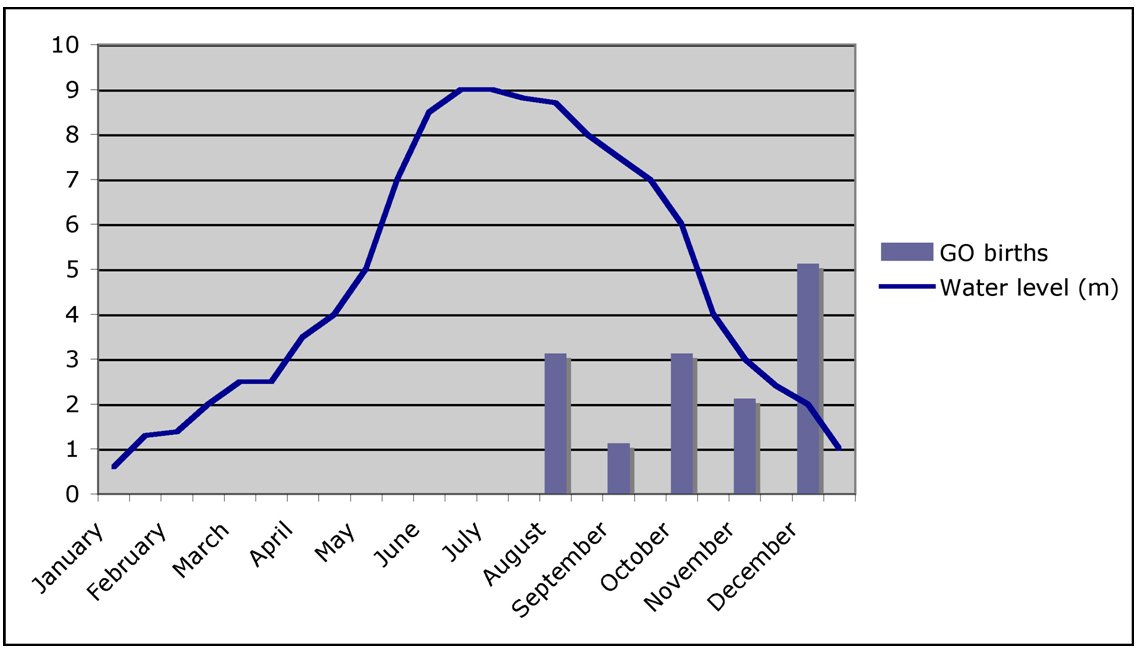 |
| Figure 1.
Water level variation in the study area and giant otter births during the study period. (click for larger version) |
The hydrologic regime in the region is influenced both by local and distant rain. There are four seasons in the year that can be described as follows: low water period (November – February), flooding period (March – May), flooded period (June – July) and receding water period (August – October). From the collected data it emerges that births in the area take place during the receding water and low water periods. According to the literature, a degree of seasonality in breeding has been recorded in very different locations within the species distribution area. The comparison of the available data is confused due to references to both the hydrological and rainfall regimes. For example, Rosas et al. (2004) found a reproductive peak in Brazil during the flooded and receding water seasons. McTurk and Spelman (2005) in Guyana report that births are concentrated at the end of the wet season while in Suriname (Duplaix, 1980) and Peru (Staib, 2005) the peak in births was registered during the dry season. Therefore, we strongly recommend that breeding season in giant otter should always refer to river water levels and not to rainfall regime. This procedure will allow the comparison of giant otter populations from different locations throughout its distribution, providing reliable data on the ecology of the species.
Direct observation and faecal analysis in various regions have revealed that fish constitute the majority of giant otter’s diet (Carter and Rosas, 1997; Rosas et al., 1999). Information on fish movements in the study area can be deducted from the alimentary habits of the local people, as fish represent the main protein source in their diet. The inhabitants of the Xixuaú Reserve, based on their traditional knowledge, describe the fishing activity as easy during the low water season, less easy during the flooding period, difficult in the flooded season and less difficult in the receding water period. Hence food availability was connected to the periodic variation of the river water level, showing a maximum in the low water season and a minimum in the flooded season. Food resources become a key factor in the reproductive period both because of the increased food demand of the mother and because of the cubs’ need to learn fishing techniques. Lactation in the giant otter lasts until the sixth month after birth but from the fourth month it diminishes in importance in the cub’s feeding (Wunnemann, 1993; Sykes-Gatz, 2004). As confirmed in this study, cubs make their first fishing attempts at 2.5 months of age, reaching certain autonomy around 3.5-4 months. Therefore, it can be assumed that the critical period of mother lactation/cub learning lasts approximately 4 months. The observed reproductive peak could have the twofold function of guaranteeing the best food availability conditions for the mother at the end of gestation and beginning of lactation, and for the cub. Reproduction during the receding water and the low water seasons assures that the delicate phase of lactation coincides with a period of medium-maximum food availability (receding water-low water) and that the phase of cub learning coincides with a period of maximum-medium food availability (low water-flooding water period).
Litter size
It has been possible to establish the size of 12 litters, which varied from 1 to 4 cubs with an average of 1.8. According to Staib (2005) large groups of giant otters tend to have a higher reproductive rate than smaller groups. For each group encountered at the Xixuaú Reserve, the number of newborns was calculated in relation to the number of adults and subadults. The results of Spearman rank analysis showed a strong positive correlation between group size and reproductive rate (Spearman rank correlation coefficient: n=12, r=0.57, P<0.01). Some reproductive habits of the species, such as the tendency to hide newborns in the den during the first weeks of life, make it difficult to gather information on the mortality rate of litters. Staib (2005) asserts, in fact, that it was not possible to establish whether a larger number of cubs were born in larger groups or a larger number of cubs died early in smaller groups. Although it has not been possible to collect information on the mortality rate, the present study confirms the existence of a positive correlation between group size and litter size.
Baby-sitting system
A strategy of altruistic behavior has been described for giant otters by several authors (Schenk and Staib, 1994; Carter and Rosas 1997; Rosas et al., 2004; Staib, 2005). In the baby-sitting system, one individual, very rarely two, remains with the newborn animals when the group leaves the den. In the study area, such behavior was never recorded. The family groups observed during the breeding period left the cubs alone inside the den and usually returned after an interval of 3-4 hours. Some differences in the habitat conditions (number of natural predators and level of anthropogenic pressure) could be responsible for intra-specific variations in different study areas and could have determined the development of a defense strategy like the baby-sitting system.
Cub development
Information on cub physical and behavioral development in the wild is limited. Some information has been gathered in captivity by monitoring otters with video cameras and microphones from hidden viewing areas (Sykes-Gatz, 2004).
During the present study, 15 family groups were observed for 228 hours in total. Seven of those bred during the study period, giving birth to 12 litters. The gathered data mostly coincide with information available in literature. Giant otters are born blind and spent about two months in the den (Duplaix, 1980). The present study confirms that during the first month the newborn animals are visible just when transferred from a den to another, carried by parents in their mouths. According to the literature, cubs probably receive some swimming lessons already during their first 15 days of life and at 67 days old they leave the den and enter the water for the first time (Hagenbeck and Wünnemann 1992; Wünnemann 1995; Autuori and Deutsch 1977 all in Sykes-Gatz, 2004). This study confirms that, at around 2 weeks old, cubs are able to float and swim although movement lacks control, immersion is superficial, the tail vibrates in the air, and the head sinks. From 1.5 months old they can be seen independently entering the water. At this age their swimming is still awkward and they are not capable of covering a great distance, their time in the water seems aimed at training them to swim and the mother may keep in close contact, supporting the cub with her legs; over greater distances the cub is still carried by parents in their mouths. At around 2 months the cubs can walk firmly on land and manage to follow the adults in the water. At around 2.5 months they join the adults more regularly and make their first unsuccessful attempts at fishing. Adults and subadults offer the cubs their own catches and may stimulate them to feed by grooming their backs. Fishing sessions are very noisy, characterized by attempts to steal the fish and high begging vocalizations. First successes in fishing can be recorded around 3.5 months. Playing seems very important in cub life and often during the day they play in the water while adults rest on a log. Cub participation in the alarm behavior of the family group increases gradually with age. At around 3 months they are already able to snort and periscope, imitating the adults, but they often periscope towards the adults rather than the perceived threat. At around 5 months they may join the adults in chasing the intruder but they are not able to distinguish the danger source and express alarm in all directions. The study confirms that not only the parents but also other group members are involved in the rearing of the cubs: siblings, adults and subadults cooperate in defending, taking care of, and teaching hunting techniques to the newborns.
ACKNOWLEDGMENTS - We are indebted to the inhabitants of the Xixuaú Reserve and to the Associação Amazônia NGO for their logistical support. Special thanks are due to the native guides Carlos Alberto Nascimento and Alexandre Soares for their important help during the fieldwork. We also extend our gratitude to Christopher J. Clark who revised the English version of this manuscript.
REFERENCES
Carter, S.K., and Rosas, F.C.W. (1997).. Biology and conservation of the giant otter Pteronura brasiliensis. Mammal Rev. 27: 1-26.
Duplaix, N. (1980). Observations on the ecology and behavior of the giant river otter Pteronura brasiliensis in Surinam. Revue Ecologique (Terre Vie) 34:, 495-620.
Groenendijk J., Hajek, F., Duplaix, N., Reuther, C., Van Damme, P., Schenk, C., Staib, E., Wallace, R., Waldemarin, H., Notin, R., Marmontel, M., Rosas, F., Mattos De, G.E., Evangelista, E., Utreras, V., Lasso, G., Jaques, H., Matos, K., Roopsind, I., Botello, J.C. (2005). Surveying and monitoring distribution and population trends of the giant otter (Pteronura brasiliensis). Habitat 16: 1-500.
Laidler, L. (1984). The behavioral ecology of the giant otter in Guyana. Doctoral Dissertation, Univ. of Cambridge 1984; 319 pp.
McTurk, D., Spelman, L. (2005). Hand-Rearing and rehabilitation of orphaned wild giant otters, Pteronura brasiliensis, on the Rupununi River, Guyana, South America. Zoo Biology 24:153–167
Rosas, F.C.W., Zuanon, J.A.S., Carter, S.K. (1999). Feeding ecology of the giant otter, Pteronura brasiliensis. Biotropica 31: 502-506
Rosas, F. C. W., Mattos, G. E., Lazzarini, S. M., Picanco, M. C. L. (2004). Sazonalidade reprodutiva de ariranha (Pteronura brasiliensis) no lago da Usina Hidrelétrica de Balbina, Amazonas, Brasil. In: XI Reunión de Trabajo de Especialistas en Mamíferos Acuáticos de América del Sur, 2004, Quito. Livro de Resumos da XI Reunión de Trabajo de Especialistas en Mamíferos Acuáticos de América del Sur, 2004. p. 94-94.
Schenck, C., Staib E. (1994). Giant otter, a giant under even bigger pressure. Wildbiologische Gesellschaft, Munich and Frankfurt Zoological Society, Frankfurt, 36 pp.
Sykes-Gatz, S. (2004). International Giant Otter Studbook Husbandry and Management Guidelines. Dortmund Zoo, Germany
Staib, E. (2005). Eco-etologia del Lobo de Rio in Peru. Spanish translation of German PhD dissertation: Öko-Ethologie von Riesenottern (Pteronura brasiliensis) in Peru. Munich University, Germany, 195 pp.
Wunnemann, K., (1993). Breeding giant otters (Pteronura brasiliensis) in Germany. Habitat 11: 75-77.
Résumé : Comportement de Reproduction de la Loutre Geante (Pteronura brasiliensis) dans la Reserve de Xixuamu, Roraima, Bresil
Une population de loutres géantes a été étudiée dans le centre de l'Amazonie brésilienne dans la réserve Xixuaú (Roraima), dans le but de recueillir des données écologiques et comportementales. Durant la période 2000-2003, 14 portées ont été enregistrées, toutes entrent les mois d’Août et Décembre au cours de la décrue et des périodes de basses eaux. Le pic de reproduction semble être dépendant de la disponibilité en nourriture dans le système fluvial. La taille des portées varie de 1 à 4 petits avec une moyenne de 1,8 (n=12). Il a été confirmé qu'une forte corrélation positive existe entre la taille du groupe et le taux de reproduction, mais aucune preuve de "baby-sitting» décrit par d'autres auteurs n'a été trouvée. L'étude fournit des informations sur le développement des loutrons et confirme que tous les membres du groupe sont impliqués dans l'élevage des petits.
Revenez au dessus
Resumen:Apareamiento de la Nutria Gigante (Pteronura brasiliensis) en la Reserva Xixuaú, Roraima, Brazi
Información sobre comportamiento y ecología fue recolectada del estudio de una población de nutrias gigantes en la reserva Xixuaú ubicada en Roraima al centro de la amazonía Brasileña. 14 camadas fueron registradas durante el periódo 2002-2003, concentradas en el lapso de unos pocos meses (Agosto-Deciembre) durante la temporada de sequía. El pico reproductivo pareciera estar conectado con la disponibilidad de comida en el sistema fluvial. El tamaño de camada varió de 1 a 4 cachorros con un promedio de 1.8 (n=12). Se confirmó una fuerte correlación entre el tamaño del grupo y la tasa de reproducción; sin embargo, no se encontro evidencia del sistema “baby-sitting” reportado por otros autores. Este estudio reporta información sobre el desarrollo de los cachorros y confirma la participacion de los miembros del grupo en la cría de los cachorros.
Vuelva a la tapa