IUCN/SSC Otter Specialist Group Bulletin

|
©IUCN/SCC Otter Specialist Group Volume 28A Proceedings Xth International Otter Colloquium, Hwacheon, South Korea Citation: Feeroz, M.M., Begum, S. and Hasan, M. K. (2011) Breeding Activities of Lutra perspicillata in Bangladesh. Proceedings of Xth International Otter Colloquium, IUCN Otter Spec. Group Bull. 28A: 38 - 44 Breeding Activities of Lutra perspicillata in Bangladesh Mohammed Mostafa Feeroz1, Mohammad Abdul Aziz2 and Padma Kumar Thanchanga3
1
Dept. of Zoology, Jahangirnagar University, Savar-1342, Dhaka, Bangladesh e-mail: feerozmm@yahoo.com |
 |
|
Abstract: A study was conducted on breeding activities of smooth coated otter (Lutra perspicillata) in Bangladesh between July 2004 and August 2006. In the present study all adult otters in captivity potentially breed throughout the year. They are aseasonal breeder in captivity. Mating was exclusively restricted to the water, where the male heldsthe female and embraced her back with his forelegs and rubbed and sniffed at her body. Mating frequency was recorded 3 to 6 times a day at its peak, but once or twice otherwise. The gestation period was found to range from 61 to 78 days. The cubs remained webbed with mucus during delivery and newborns were blind with whitish body covered by sparse short fur. Litter size varied from 2 to 5 cubs. It has been found that the weight of the newborns decreased after birth until the second week and then increased gradually. Cubs opened the eyes in 4 to 5 weeks and started to take solid food at 7 to 8 weeks. The average weight of the infants at birth was 195 g. The average length of the first day infants were measured as 24.4 cm. Breeding success was recorded as 100% in case of litter of size of 3 or smaller while less than 80% in case of litter of size of 4 or bigger. |
| Keywords: Breeding activities, Lutra perspicillata, breeding success, Bangladesh |
| Française | Español |
INTRODUCTION
Among the three otter species found in Bangladesh, smooth coated otters (Lutra perspicillata, Geoffroy, 1826) are widely distributed and found in all major wetland habitats. Because of rapid degradation of the habitats, food scarcity and poor breeding facilities, this species become endangered (IUCN, 2000) and locally extinct from much natural habitat in the country. On the other hand, a population (176 individual, Feeroz et al., 2011) of this species is found in asemi-captivite condition where they are used for fishing by a group of fisherman. It seems this species can potentially breed if food and shelter are provided. Specific priorities should be defined for its conservation and breeding in captivity, which might be one of the strategies for conservation of this species. Data on reproductive performance are thus essential to monitoring population dynamics.
Unfortunately very little is known about the reproductive biology and ecology of L. perspicillata in Bangladesh. For an in-depth understanding of the breeding activities of the species, a study was conducted on L. perspicillata in captivity, which revealed the breeding potential and will help develop a management plan for ex-situ conservation of this species.
METHODS
A study on the breeding activities of smooth coated otter (L. perspicillata) was conducted between July 2004 and August 2006 on 14 groups of otters, living in different captive conditions: (a) the natural confined area of the Wildlife Rescue Centre, Jahangirnagar University (1 family), (b) the Dhaka Zoo (1 family) and (c) semi captivity in fishermen villages at Norile district near Sundarbans (12 families used for fishing). Breeding activities were recorded by using scan sampling (Altmann, 1974) with 15 minutes intervals from dawn to dusk. Beside scan samples, ad libitum notes (as a shorthand summary) describing any event were taken. Gestation period was calculated between the first mating and the birth.
Growth and development of 9 cubs of L. perspicillata were studied among the captive breed from the first day to the 14th weeks of age through morphometric data collection. Body weight and length were measured the first day of each week during this period. Breeding success was calculated with the following formula: Breeding success = total alive/total birth x 100.
Results
Breeding activities of L. perspicillata were found throughout the year. More than 90% of the adult females gave birth within 3 to 4 years of age in semi-captive conditions. Female became mature after 3 years but males took more time for maturation and 94% of them were reported to mate after 4 years.
Courtship and mating:Courtship behavior was observed during all months while mating was more frequent from May to August. Estrus lasts 12 to 14 days. Mating was not observed among siblings. Mating was only recorded in the water which was a vigorous event. During the process, the male seized the female and embraced her back with forelegs and rubbed and sniffed at her body. Mating frequency was recorded 3 to 6 times a day at the peak period, while reducing to once or twice either side of this. The pregnant female led a more solitary life but become more ferocious than the non-pregnant female. It has been observed that rest was the major activity during the late pregnancy, which might be due to the massive increase of the lower abdomen.
Birth and parental care: The studied population of L. perspicillata bred aseasonally i.e., female gave birth throughout the year. Nevertheless a breeding peak was recorded, from September to November (Fig.1).
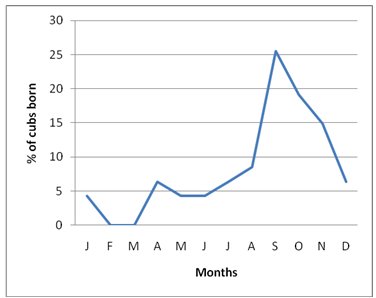 |
| Figure 1. Birth of L. perspicillata in different months |
Usually, the female made a saucer-shaped hole in their breeding ground. This behaviour was not found in captivity where ground soil was unavailable. The mother was found to cry out just before birth, the call rather different from the normal one. A total of 47 births were recorded during the study period. Gestation period was found to range from 61-78 days (mean = 68.82, sd ± 5.53, n = 14) for the present study. Gestation period was strongly dependent on the litter size (r=0.803, r2 =0.644), which presented a mean of 3.4 (range 2 to 5, sd ± 1.1; n = 14; Fig. 2). An interval of 12 to 20 minutes was observed between the delivering of the cubs. Placental clearance was recorded half an hour after the birth of the last cub. The newborns remained webbed with mucus, and were blind with whitish bodies covered with sparse. short fur.
Otters being nidiculous animals, the eyes of the cubs opened between 16 to 26 days after birth. The mother needed to help facilitate dispersion of the cub’s fecal matter for about 7 days. She rubbed the anal area of each infant with her snout to clearing the attached fecal matter.
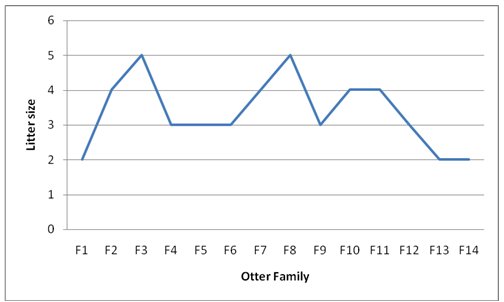 |
| Figure 2. Litter size among the 14 studied families of L. perspicillata |
Growth and development: The average weight of the infants in the first week was 195 gm (ranges = 185-200 g; n = 9, sd ± 5.07; Table 1). The weight rose by nearly 1 kg within one month and at the end of the 3rd month they become more than 3.5 kg (Table 1). All infants were found to gain weight in a linear fashion with few marginal variations. The infants gained average weight of 271 g per week from the birth to the 14th week. During this time, the maximum weight (413.89 g) was gained at the age of 7 weeks and then gradually decreased. At birth the weight of male and female infants did not vary considerably. The weight gain of female infants showed the most ups and downs in development throughout the study period while male infants gained weight steadily. It has been observed that all infants were found to grow up rapidly from birth up to the 14th week and then the development became gradually slower. It was also found that the infants born later were smaller than the first born one. The average length of the first day infants was measured as 24.4 cm (Table 1). Lengths gained each week varied from 2 to 7 cm. From the 9th week they gained equal length each week until the 14th week.
Breeding success: No predation or accidental death of an infant was recorded. All the deaths were natural either because of coldness (in one case) and shortage of food (access to mother’s milk). A total of 5 infants out of 47 born died during the study period. Overall breeding success was calculated as 89.4% in this study. Breeding success was found to be 100% for litter sizes of 3 or smaller while less than 80% where the litter size was 4 or bigger. Of the infants who died, half were in completely captive conditions in the Zoo while no infants at all died in the confined natural habitat at the Wildlife Rescue Centre.
Very few data are available on the breeding activities of this species in Bangladesh to compare with the present study. Kashem (1997), in the early 1990’s, reported this species as an aseasonal breeder. Though no birth was recorded in February and March during this study, several previous records of birth during these months were confirmed by the fisherman owners of the tamed otters. Desai (1974) found that in captivity, mating occurs in August and parturition mostly occurs in October. In the wild, parturition occurs throughout the year if weather is good and food supply is abundant (Foster-Turley, 1992). But breeding of this species is reported in winter (October - February) in some other countries (Hussain, 1996). Many studies of otter reproduction carried out in Europe showed considerable differences in reproductive timing and seasonality. Although female otters were reported to be continuously polyoestrous (Gorman et al., 1978; Mead, 1989) and therefore able to give birth throughout the year, reproduction ranges from nearly seasonal (Kruuk et al., 1987; Erlinge, 1967, 1968) to non-seasonal birth with peaks at different times of the year (Sidorovich, 1991; Tumanov and Sidorovich, 1994; Beja, 1996; Elmeros and Madsen, 1999). It has been found that mothers which lost their cubs in early infancy became ready for breeding within a month; breeding time therefore could be random throughout the year. Londono and Munoz (2006) found that if neonates died soon after birth, the next litter was born after a period of 77 days or more.
Results regarding breeding success in this study showed that females with small litter sizes can provide enough food and care unlike those that have larger litters. However, it seems that parents can provide adequate food for themselves as well as for their cubs in secured and less disturbed environments or habitats. Results obtained from the family in the natural confined area at the Wildlife Rescue Centre suggest that good habitats with enough food and little human interference can enhance and ensure breeding potentiality and success as well as survival. Due to the drastic decline of the natural otter population and rapid degradation of its habitats in the country, ex-situ conservation can be the ultimate and last hope to help save this species from extinction through reintroduction and rehabilitation of this wetland ambassador to its former and restored habitat in Bangladesh.
ACKNOWLEDGMENTS - We are grateful to the fishermen community for allowing us to work on their otters and to share their knowledge. We are indebted to Prof. Padma K. de Silva of the University of Peradeniya, Sri Lanka for her constant support concerning otter conservation in Bangladesh. We want to thanks Wildlife Rescue Centre, Jahangirnagar University and Dhaka Zoo for allowing us to study otters in their captivity.
REFERENCES
Altmann, J. (1974). Observational study of behaviour: sampling methods. Behaviour 49: 222-267.
Beja, P.R. (1996). Seasonal breeding and food resources of otters, Lutra lutra (Carnivora, Mustelidae), in South West Portugal: a comparison between coastal and inland habitats. Mammalia 60: 27-34.
Desai, J.H. (1974). Observations on the breeding habits of the Indian smooth otter. Int. Zoo Yb.14: 123-124.
Elmeros, M., Madsen, A. (1999). On the reproduction biology of otters (Lutra lutra) from Denmark. Z. Säugetierk.64: 193-200.
Erlinge, S. (1967). Food habits of the fish-otter Lutra lutra L. in South Swedish habitats. Viltrevy, 4: 371-443.
Erlinge, S. (1968). Territoriality of the otter Lutra lutra. Oikos, 19: 81-98
Feeroz, M.M., Begum S., Hasan, M.K. (2011). Fishing with otter: A traditional conservation practice in Bangladesh. IUCN Otter Spec. Group Bull. 28A: 14-20.
Foster-Turley, P. (1992). Conservation aspects of the ecology of Asian small-clawed and smooth otters on the Malay Peninsula. IUCN Otter Spec. Group Bull. 7: 26–29.
Gorman, M.L., Jenkins, D., Harper, R.J. (1978). The anal scent sacs of the otter (Lutra lutra). J. Zoology (London) 186:, 463–474.
Hussain, S.A. (1996). Group size, group structure and breeding in smooth-coated otter Lutra perspicillata Geoffroy in National Chambal Sanctuary. Mammalia 60: 289-297.
Kashem, T. (1997). Ecology and behavior of otters of Bangladesh. M.Sc. Thesis. Jahangirnagar University, Bangladesh.
IUCN-Bangladesh (2000). Red Book of Threatened Mammals of Bangladesh. IUCN-The World Conservation Union.xii+71pp.
Kruuk. H., Conroy, J.W.H. (1991). Mortality of otters (Lutra lutra) in Shetland (Scotland, UK). J. Appl. Ecol.28: 83-94.
Londono, G.C., Munoz, N.T. (2006). Reproduction, behaviour and biology of the Giant river otter Pteronura brasiliensis at Cali Zoo. Int. Zoo Yb.40: 360–371
Mead, R.A. (1989). Reproduction in mustelids. In: Seal, U.S., Thorne, E.T., Bogan, M.A., Anderson, S.H. (eds). Conservation biology and the black-footed ferret. New Haven: Yale University Press, 124-137.
Sidorovich V.E. (1991). Structure, reproductive status and dynamics of the otter population in Byelorussia. Acta Theriologica 36: 153-162.
Tumanov I.L., Sidorovich V.E. (1994). Reproductive features of the otter (Lutra lutra L.). Lutreola 4: 1-4.
Résumé : Comportements de Reproduction chez Lutra perspicillata au Bangladesh
Une étude a été menée sur les comportements de reproduction de la Loutre à pelage lisse (Lutra perspicillata) au Bangladesh entre juillet 2004 et août 2006. Dans cette étude, toutes les loutres adultes élevées en captivité se reproduisent potentiellement toute l'année. Il n’existe pas de saisonnalité de la reproduction en captivité. L'accouplement a exclusivement lieu dans l'eau où le mâle maintient la femelle en l’enserrant avec ses membres antérieurs frottant et reniflant son corps. La fréquence d'accouplement est de 3 à 6 fois par jour au maximum pour une ou deux fois en temps normal. La période de gestation couvre 61 à 78 jours. Les loutrons naissent palmés, aveugles avec un corps blanchâtre couvert d’une rare et courte fourrure. La taille des portées varie 2 à 5 loutrons. Il a été constaté que le poids des nouveau-nés a diminué après la naissance jusqu'à la deuxième semaine pour augmenter ensuite progressivement. Les loutrons ouvrent les yeux vers la quatrième ou cinquième semaine et commencent à prendre les aliments solides à 7-8 semaines. Le poids moyen à la naissance était de 195 g. La longueur moyenne lors des premiers jours était de 24,4 cm. Le succès de reproduction est de 100% pour les portées de 3 petits au maximum alors qu’il est de moins de 80% dans le cas de portées supérieures à 4 loutrons.
Revenez au dessus
Resumen:Reproducción de la Lutra perspicillata en Bangladesh
Un studio sobre las actividades de apareamiento de la nutria de pelaje fino (Lutra perspicillata) fué realizado en Bangladesh entre los mesed de Julio y Agosto del año 2006. En el presente studio todas las nutrias adultas en cautiverio se reprodujeron durante todo el año. Ellas son reproductoras no estacionales en cautiverio. El apareamiento se sucedió exclusivamente en el agua donde el macho retiene a la hembra, la abraza con sus patas delanteras mientras frota y uele su cuerpo. La frecuencia de apareamiento fue registrada de 3 a 6 veces al dia durante períodos pico, mientras que una o dos veces en condiciones normales. Los períodos de gestación fueron de 61 a 78 días. Los cachorros se mantienen recubiertos de membranas mucosas durante el parto y los recién nacidos son ciegos con el cuerpo blanquecino y cubiertos por un pelaje corto y escaso. El tamaño de la litera varió de entre dos a cinco cachorros. Se encontró que el peso de los recién nacidos disminuía luego del nacimiento y hasta la segunda semana cuando comenzaba a incrementar gradualmente. Los cachorros abrieron los ojos de 4 a 5 semanas y comenzaron a tomar alimentos sólidos entre las semanas 7 y 8. El peso promedio de los cachorros al momento del nacimiento fue 195 g, y el largo de los recién nacidos de un día fue 24.4 cm. Éxito reproductor fue 100% para literas de 3 cachorros o más pequeñas, mientras que fue menos del 80% para literas de 4 cachorros o de mayor número.
Vuelva a la tapa