IUCN/SSC Otter Specialist Group Bulletin

|
©IUCN/SCC Otter Specialist Group Volume 28A Proceedings Xth International Otter Colloquium, Hwacheon, South Korea Citation: Hönigsfeld-Adamič, M. and Smole, J. (2011) Phototraps as a Non-Invasive Method of Monitoring Otters (Lutra lutra): What can we Expect? . Proceedings of Xth International Otter Colloquium, IUCN Otter Spec. Group Bull. 28A: 60 - 69 Phototraps as a Non-Invasive Method of Monitoring Otters (Lutra lutra): What can we Expect? Marjana Hönigsfeld-Adamič1 and Jakob Smole1
1LUTRA, Institute for Conservation of Natural Heritage, Opekarska 11, SI-1000 Ljubljana, Slovenia Email: marjana@lutra.si |
 |
| (Received 23rd March 2011, accepted 14th July 2011) |
|
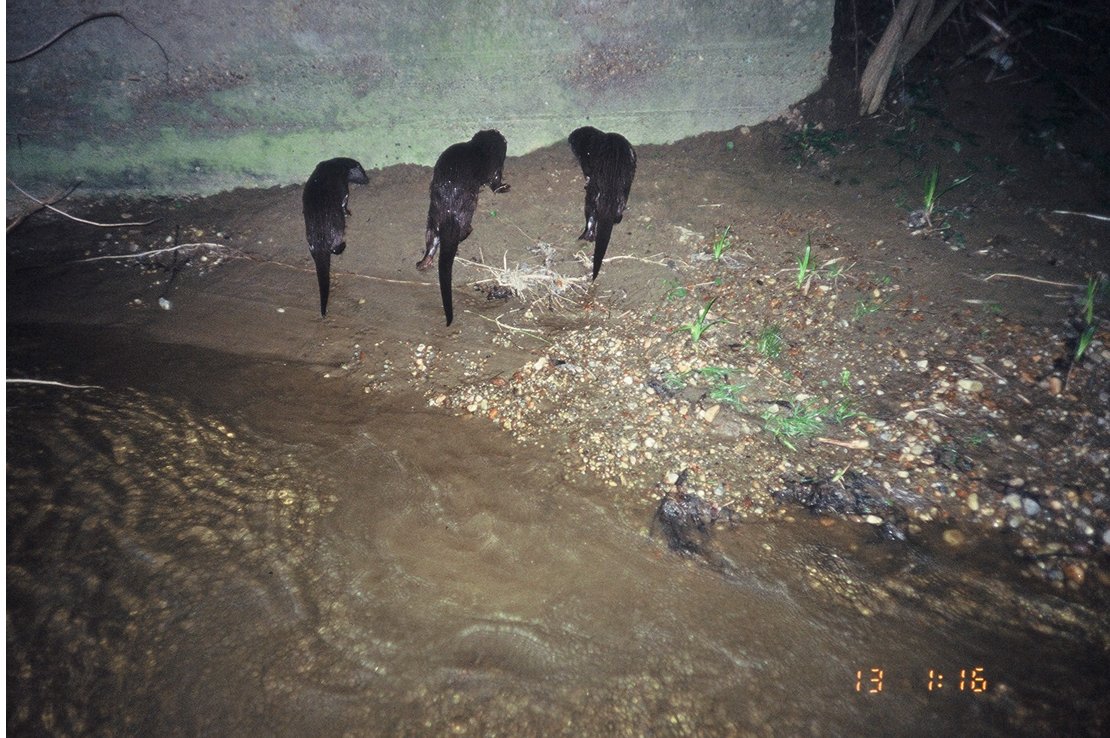
Abstract: In the frame of the EU project LIFE III – NATURA, running for the 3rd year in northeastern part of Republic of Slovenia, a series of 5 – 10 passive infrared cameras is used for monitoring otters (Lutra lutra) in the area of Landscape Park Goričko (390 km2). Our special attention is focused on main otter and watercourse corridor running through the area, all the way followed by the road and a new railway (finished 2001). Establishing and consequently mitigating the possible negative influence of railway on the otter population was the primary aim of camera monitoring. Simultaneously, classic method of monitoring otters is used, collecting spraints. The comparison between results planned and actual preliminary results shows, that most of the planned cameras’ purposes cannot be fulfilled, for instance distinction of individual animals, due to different objective reasons. On the other hand, some new interesting characteristics of population have been discovered, such as recording of otter family life, as well as unexpected threats to the population. Finally, on the basis of camera monitoring it is assumed that the density of otter population living in the area was overestimated at the beginning of the project, although the water network in the area is fully covered with otters all the time. |
| Keywords:otter, Lutra lutra; Slovenia; monitoring; infrared cameras; railway |
| Française | Español |
INTRODUCTION
In the frame of the project LIFE III – NATURA, titled Conservation of otter population (Lutra lutra) in Goričko - Phase 1, lasting from November 2004 till October 2008, we decided to use the non-invasive research methods exclusively. Besides regular monitoring of the otters by checking their sprainting-sites and collecting fresh samples for DNA analysis (the results will be known in the last project year) we are also performing monitoring by the means of passive infrared cameras.
Otter activity has been studied by various methods and techniques already, from direct observations (Kruuk, 1995) to radio tracking (Kranz, 1995; Saavedra, 2002) and spraint collecting. However, some methods of assessing the otter activity on the basis of spraints have proven to be only partially reliable, since the otters have deposited spraints in only about half of the nights they have visited the latrines (Guter and Alii, 2007), whereas the tracking of the otter by the means of radio- or satellite transmitters is very time consuming and requires large amounts of manpower. Furthermore, equipping the otter with the transmitter is considered an invasive method exposing the animal to a heavy stress. Surprisingly, relatively few studies using remote cameras have been carried out on otters. Some information about the use of these systems was reported by Chanin (2003) and Guter et al (2008).
The application of a camera for documenting wildlife was introduced in 1888 by George Shiras III (Sanderson, 2005). Since then, the technique has been improved, the remote sensor has been added, and nowadays the remote cameras use digital technology and have large operating autonomy. They are widely used to record nocturnal animals and to assess their populations in the difficult accessible habitats, for instance rainforest (Sanderson; 2004); the remote cameras are also of great help in wildlife management of deer populations (Jacobson; 2002).
MATERIAL AND METHODS
Study area
The territory between the River Mura in the southwest and the catchment of the River Raab (Hungary) in the northeast, is called Prekmurje. Within Slovenia, it is the only real part of the Pannonia with a continental climate; the average temperatures in January and July are -3,2 °C and 20,1 °C, respectively.
The study area was restricted to the Landscape Park Goričko (390 km2) in the north of Prekmurje. It is a hilly landscape with a maximum elevation of 418 m above sea level. The southern border consists of the diluvial terraces above the River Ledava, the northern border being the watershed between the Rivers Raab and Mura. Small watercourses, rising in the hills and draining in a southeast direction, form a typical dendritic pattern belonging to the Mura catchment. No natural lakes occur in the area of Goričko, therefore 4 water reservoirs with the surface ranging from 3 to 70 ha and a lot of small fishponds are of great importance as a secondary water habitat (Fig. 1).
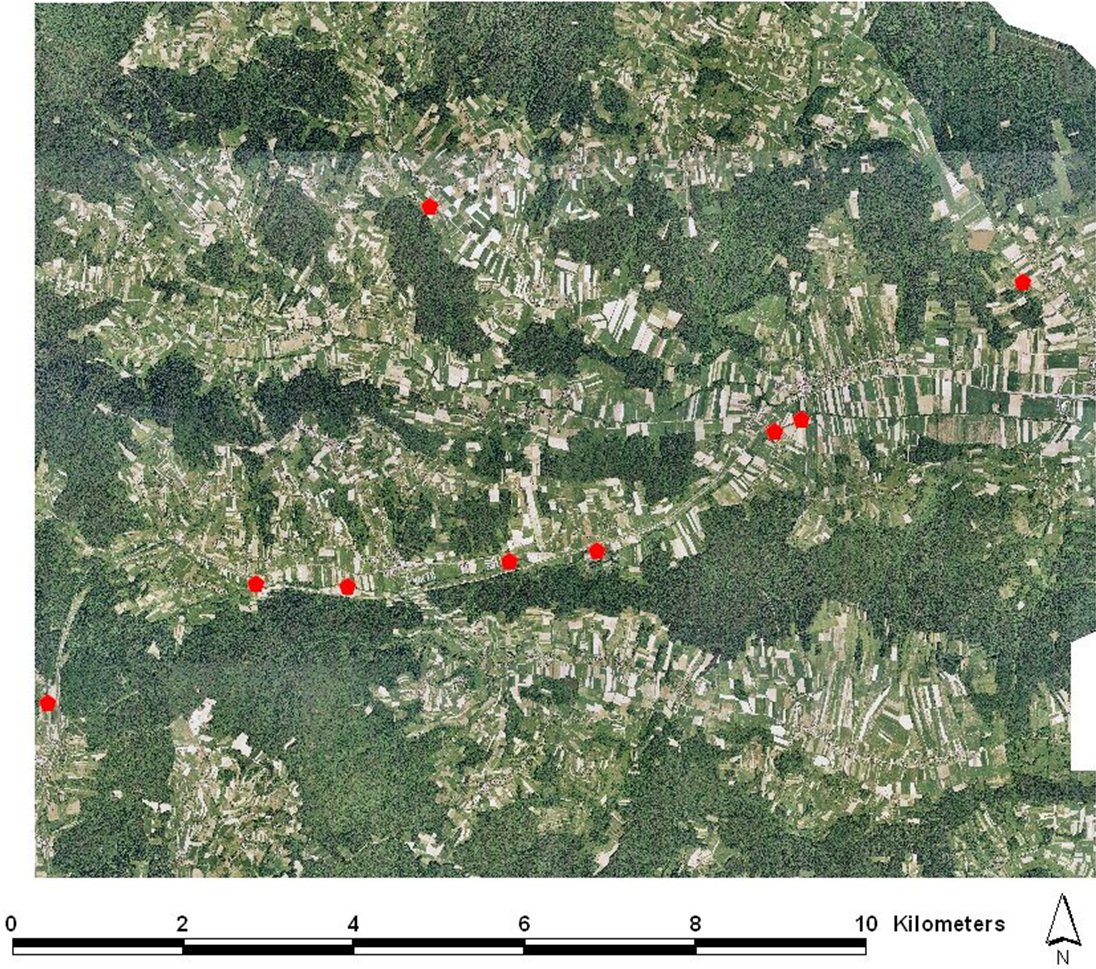 |
| Figure 1. The sites where the remote camera systems were situated (click for larger version) |
For the purpose of our research, 10 phototrap systems, consisting of passive infrared sensor Trailmaster TM 550 and a 35-mm camera Canon Prima AS-1 with the date and time option, were mounted under the bridges along 4 small streams, where otter paths were known and checked for several years; the majority of phototrap systems (6) were set along the main stream Peskovci, and 1 on each of the streams Velika Krka, Dolenci and Mačkovci. Both, cameras and sensors are quoted weather- but not waterproof by the manufacturer. The type of film used was Fuji Provia 400X 35 mm, in certain cases (depending on distance) pushed for one or two stops in post processing.
The TM550 is a passive infrared trail monitor that detects the combination of body heat-and-motion in the area it is monitoring. Recording the presence of animals in the chosen area is done by recording times that the unit detects warm-blooded animal movement within its area of sensitivity. Typically, this is about 20 m deep, spreading 150° wide and 4° high. Sensor's detecting sensibility can be adjusted with two parameters, the first being the number of infrared beams which animal should interrupt, and the second the time period within which this should happen to trigger the camera. Furthermore, the triggering interval of the camera could be defined. Depending on the width of the bridge, the detecting sensibility has been set on 2 - 3 beams with the 5 – 8 sec time period. The operating time of the camera has also been set according to the site; the daylight may trigger the camera thus consuming the film, therefore the systems were set to operate during the nighttime only. Laser beam was used to direct the sensors in a way to cover the otter path; Scotch tape was used to synchronize the angle with the camera’s angle. The sites with photo-traps were monitored regularly every 2 to 3 days in order to change the films, batteries and to check the water level in the stream.
RESULTS
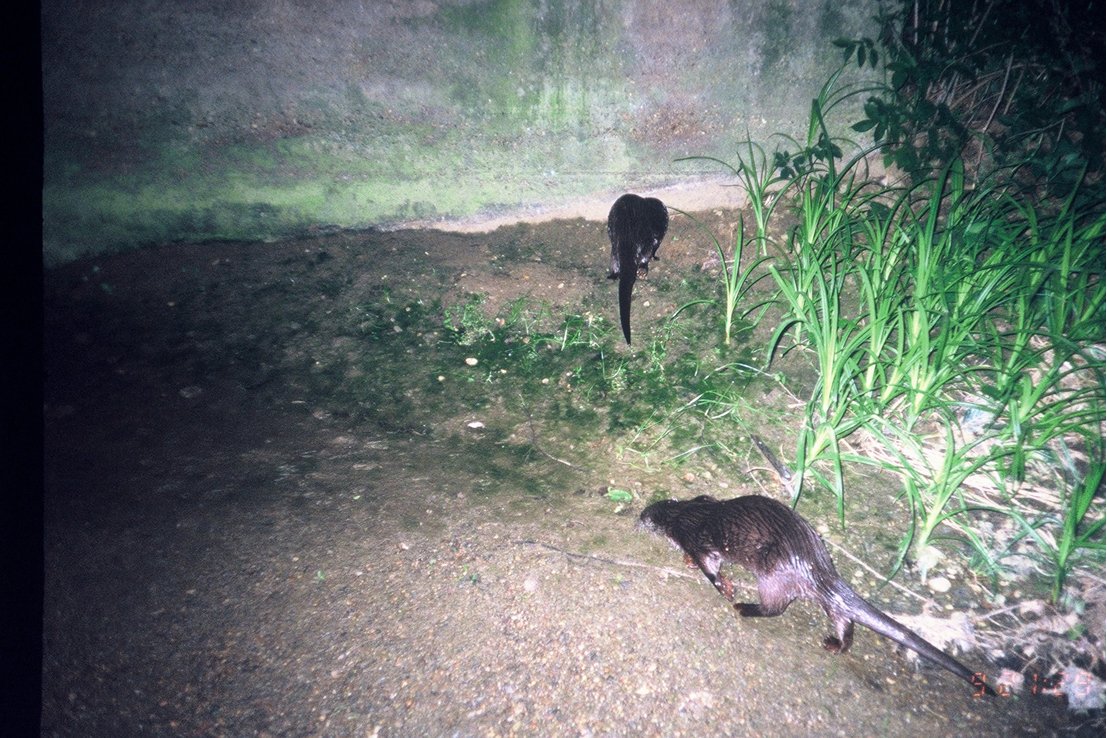
In the period from 6. 12. 2005 till 6. 7. 2007, 53 film rolls (36 snaps each) were spent, out of this 121 otter photos were obtained (Fig. 2). Sixteen of them carried no date and time. Three photo-trap systems were flooded in a sudden water rise due to the heavy local fall of rain, and one was stolen. One of the flooded systems could be repaired and later we have received one additional system. The cameras were active for 3218 shot-nights altogether.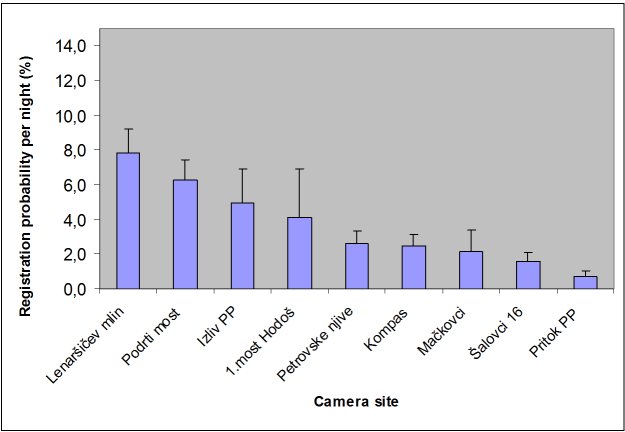 |
| Figure 2. Probability of otter registration per site. |
We can conclude that in the research period the area was inhabited by 2-3 adult and 3 juvenile otters. The exact number of adult individuals could not be determined because the unambiguous recognition of individuals was not possible. Nevertheless, on the base of data obtained with the chain of cameras set along the main stream in the area and data extrapolated to the whole project area we got the approximate number of 17 (16,67) adult otters occupying the area. This is only 34% from the 50 individuals, which was the minimum number assessed with the methodology of “best expert opinion” (Hönigsfeld Adamič and Perovšek, 2003); the results suggests how inaccurate and dangerous the method very widely used in candidate countries for membership in the EU in 2004 could be.
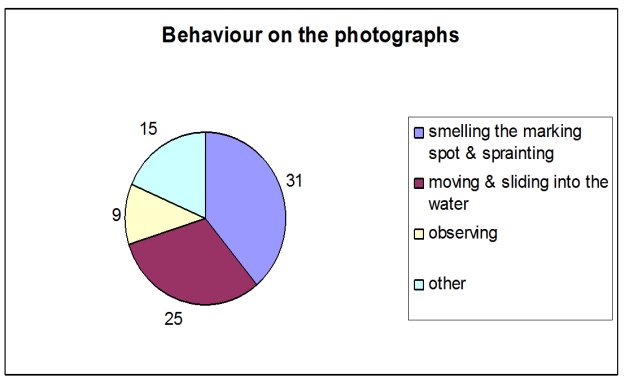
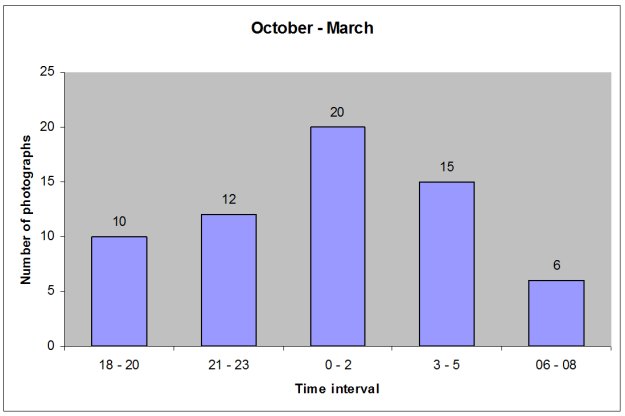
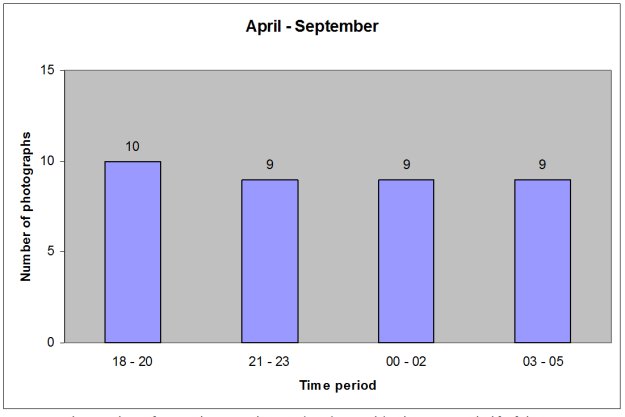
The most frequent behaviour pattern has been sniffing/marking the sprainting sites and walking along the bank (Fig. 3). The behaviour and activity time by of adult and juvenile animals did not differ significantly. In the winter period, the peak of activity was around midnight (Fig. 4), while in the summer period, the visits seem to be dispersed through the whole night (Figure 5). However, this difference is not significant and the data can serve merely as an orientation.
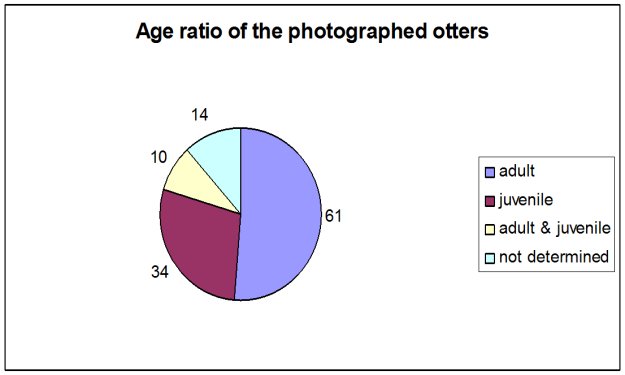
Besides otters, the remote cameras have recorded 24 other animal species, domestic animals (dogs and cats), red fox (Vulpes vulpes), Eurasian badger (Meles meles), pine marten (Martes foina) and beech marten (Martes martes), European polecat (Mustela putorius), least weasel (Mustela nivalis) and 2 insectivore, 4 rodent and 2 deer species.
The use of remote cameras as a method for following the otter activity is not efficient enough, if we are expecting accurate assessment of the population properties. There are several reasons for this statement. The major factor lies within the technical limitations of the equipment. On many occasions, the date and time were not imprinted on the slides due to unknown reasons (the batteries were fresh, the date on the same film before and after the particular slide was imprinted correctly). Next factor with a great impact was the film as a medium, which has a limited capacity in a physical respect. The film has often been spent in one night due to other animals´ activity (i.e. mustelids, foxes, rodent species, domestic animals, or unknown factors) and the camera was not effective for several days before the film roll was changed. With the new generation of digital cameras this problem diminishes, since the number of photographs the memory card can store can be as high as few thousand.
Other limitations arise from the sensor properties. Due to its small vertical beam angle the otters have often evaded it, passing under its detection area. The otter paths changed according to the water level; since the water level could fall or rise significantly within few hours, the sensor did not register the animal; however, in the time of monitoring the spraints or footprints were found, whereas the camera did not take a picture.
Another problem is the difference between the sensor and camera angle, with the sensor having a broader detection angle for visibility angle than the camera. Sensor's angle has been narrowed with the Scotch tape, but in several cases the adjustment was not sufficient: the camera took an “empty” picture (no animal appearing on it), although the latter had been detected by the sensor.
Also the site properties have played a big role. On most sites, the otter used both banks to mark. However, the sensor was directed only to one bank, thus allowing the animals passing along the bank with sensor but still remaining undetected. So it has happened that we found otter signs on the same side as the sensor but having no pictures were taken.
Unexpected result of the using the remote cameras was the detection of the so far underestimated threat for otters - domestic dogs. They are passing under the bridges mostly in the same time periods as the otters do. From the area of Goričko only, three cases of dogs killing an otter have been reported in last two years (of course, there could have been many cases not recorded). Beside traffic and illegal hunting the domestic dogs are now believed to be an important factor of otter mortality.
The multiple remote camera systems cannot monitor daily activity of the otter reliably, due to many factors that influence the results, even if camera systems would be set up in a row along the stream. However they can provide good assessment of the population size on certain area, for a certain activity interval and in a certain period of the year, however, also with much less than 9 installed remote camera systems. For the installation, the proper site should be found on the appropriate bank, safe from sudden water rise. With the use of digital technology the time amount necessary for inspection of remote cameras could be greatly reduced and costs lowered with the results of equal or even better quality.
Provided camera trapping is combined with other methods, i.e. investigating sprainting sites and/or performing DNA analyses of spraints, the technique of monitoring otters with remote cameras could offer a precious additional tool in discovering secrets of otter´s life.
CONCLUSIONS
In the frame of the LIFE-NATURA project Conservation of otter population in Goričko (Slovenia) following disadvantages as well as advantages of remote camera systems were established:Disadvantages:
- The method lacks systematic approach more than it may be foreseen;
- Safety of the systems regarding human factor must be considered in advance and the decision made about opened or restricted approach, depending on local circumstances;
- Due to the vicinity of water, the fact, which cannot be avoided, the risk of flooding and thus loosing at least the sensor must be taken into consideration;
- Despite a wide range of settings available the technique is not selective enough to eliminate other triggers but otters;
- The camera may not “see” what the sensor does;
- The individual identification of the otters is not reliable unless the animals are marked (which demands intervention beyond our scope of non-invasive techniques);
- Comparing to results obtained, the technique is very expensive;
- It is absolutely non-invasive method, safe and not interfering with otter’s life.
- The technique offers a variety of otter photographs of great documentary value, which are useful in education and public awareness rising activities as well as in public and media relations.
- In a particular area, the remote cameras can provide an assessment of otter population size.
- The photographs, obtained from remote cameras, offer us a close view into the secrets of otter’s intimate life we would otherwise never experience.
- Provided combining with other methods of monitoring it is eloquent evidence of otter presence to which everybody will believe.
- The detection of additional threats is enabled (e.g. dogs).
- The method provides us with an overview of other wildlife species present on the particular area, also with possible newcomers (autochtonous, e.g. a beaver, or alochtonous, i.e. a racoon).
REFERENCES
Chanin, P. (2003). Monitoring the Otter. Conserving Natura 2000 Rivers Monitoring Series No. 10. English Nature, Peterborough.
Guter A., A. Dolev, D. Saltz, N. Kronfeld-Schor, (2008). Using videotaping to validate the use of spraints as an index of Eurasian otter (Lutra lutra) activity. Ecological Indicators, 8: 462 – 465.
Hönigsfeld Adamič, M., Perovšek, D. (2003). Expert base for designating Natura 2000 areas for the otter (Lutra lutra) in Slovenia. Final report for the Ministry of Environment and Spatial Planning of the Republic of Slovenia. LUTRA, Institute for Conservation of Natural Heritage.
Jacobson, H.A. (2002). Censusing deer populations using remote cameras. Use of Remote-sensing Cameras in Wildlife Management. Kerrville, Texas.
Kranz, A. (1995). On the ecology of otters (Lutra lutra) in Central Europe. Doctoral dissertation. University for agriculture, Vienna.
Kruuk, H. (1995). Wild Otters. Predation and Populations. - Oxford University Press Inc., New York.
Saavedra, D. (2002). Reintroduction of the Eurasian otter (Lutra Lutra) in Muga and Fluvià basins (North-eastern Spain): Viability, development, monitoring and trends of the new population. PhD Thesis, University of Girona.
Sanderson, J.G. (2004). Camera Phototrapping Monitoring Protocol. The Tropical Ecology, Assessment and Monitoring (TEAM) Team Initiative, Washington.
Sanderson, J.G., Trolle, M. (2005). Monitoring Elusive Mammals.
Résumé : Pieges Photographiques en tant que Méthode Non-Invasive de Suivi des Loutres (Lutra lutra) - Que peut-on en Attendre?
Dans le cadre du projet LIFE III - NATURA 2000, qui entre dans sa 3ème année dans la partie nord-est de la République slovène, une série de 5 à 10 caméras passives à infrarouge est utilisée pour le suivi des loutres (Lutra lutra) dans le Parc de Goričko (390 km2). Une attention particulière est portée sur la loutre et le réseau hydrographiques qui traverse la région, le tout traversé de routes et d’une nouvelle voie de chemin de fer (terminée en 2001). Le premier objectif du suivi par caméras vidéo est de déterminer, et par la suite limiter l'influence négative éventuelle de la voie ferrée sur la population de loutres. Simultanément, la méthode classique de suivi des loutres par la recherche et la collecte d’épreintes a été utilisée. La comparaison entre les résultats attendus et réels montre que la plupart des objectifs devant être atteint grâce à la caméra ne peuvent malheureusement pas l’être comme par exemple la distinction individuelle des animaux. Par contre, des caractéristiques intéressantes de la population ont été découvertes tels que l'enregistrement de séquences de vie de familles de loutres ou celui de menaces inattendues pesant sur la population. Enfin, sur la base du suivi par caméra, il est clair que la densité de loutres vivant dans la région a été surestimée en début de projet bien que le réseau hydrographique de la zone soit en permanence fréquenté par les loutres
Revenez au dessus
Resumen: Fototrampas como Mètodo no Invasivo para el Monitoreo Nutrias (Lutra lutra) – Que podemos Esperar?
En el marco del projecto LIFE III – NATURA de la UE operando por 3er año en la parte nordeste de la República de Eslovenia, una serie de 5 a 10 cámaras infrarrojas pasivas fueron utilizadas para el monitoreo de nutrias (Lutra lutra) en el área de Landscape Park Goričko (390 km2). Atención especial fué dedicada a curso principal de agua y corredor de nutrias a través del área de estudio, siguiendo la carretera y la nueva vía férrea (terminada en el año 2011). Establecer y por consecuencia mitigar el posible impacto negativo de la nueva vía férrea sobre la población de nutrias fue el principal objetivo del monitoreo con cámaras.
Simultáneamente, el método clásico monitoreo de colectar heces fue utilizado. La comparación entre los resultados planeados y los resultados preliminares muestra que la mayoría de los objetivos planificadas de las cámaras no fueron obtenidos; por ejemplo la identificación de animales individuales. De otra parte, algunas características interesantes sobre la población de nutrias y su vida familiar fueron registradas, así como algunas amenazas a la población no consideradas previamente. Finalmente, acorde con el monitoreo con cámaras se asume que la densidad de población de nutrias que habitan el área fue sobre-estimada al comienzo del proyecto. A pesar que la red aquifera de la región esta completamente cubierta con nutrias todo el tiempo.
Vuelva a la tapa