IUCN/SSC Otter Specialist Group Bulletin

|
©IUCN/SCC Otter Specialist Group Volume 28A Proceedings Xth International Otter Colloquium, Hwacheon, South Korea Citation: de Silva, P.K. (2011) Status of Otter Species in the Asian Region Status for 2007. Proceedings of Xth International Otter Colloquium, IUCN Otter Spec. Group Bull. 28A: 97 - 107 Status of Otter Species in the Asian Region Status for 2007 Padma K. de Silva |
 |
| (Received 23rd March 2011, accepted 6th September 2011) |
|
Abstract: Four species of river otter inhabit the Asian wetlands, while one species of sea otter of which there is little ecological information so far is found in the coastal areas of northern Japan. Of the river-otters, the status of small-clawed otter, smooth-coated otter and Eurasian otter are fairly well known in most countries, except that there is hardly any information from countries in west Asia. The hairy-nosed otter, which was not recorded for more than two decades, was rediscovered in Thailand and Vietnam in 1999 and 2000, respectively. In 2002, evidence for the presence of hairy-nosed otter was found in Cambodia as well. In highly industrialized Asian countries there appears to be no wild otter populations, pollution and destruction of otter habitats probably being the major factors that contributed to this extinction. Legal protection is also lacking in some countries and the otters are still being killed for their organs for indigenous medicine and skins for making warm apparels. Asian people in general are unaware of the importance of otter in the wetlands. Therefore, efforts are being made to carryout awareness & training programs and otter surveys, particularly on hairy-nosed otter. In March 2006 a training workshop was held in Nepal on otter survey techniques and a similar training program would probably be held either in Vietnam or in Cambodia in 2008. General surveys on otter are in progress in S. Korea, China, India (North & South) and Sri Lanka, while ecological work on hairy-nosed otter is being carried out in Thailand, Vietnam, Cambodia and Indonesia (Sumatra). Several of these projects are being funded by the small grants provided by the Columbus Zoo Organization, US, Japanese Otter Specialist Group, Japan & International Otter Survival Fund, UK. |
| Française | Español |
INTRODUCTION
Of the 13 species of otter species in the world, four species of river otter inhabit the Asian wetlands while a single species of sea otter (Enhydra lutris L.) inhabits the North Pacific coastal waters. The river otters are the Eurasian otter (Lutra lutra L.), small-clawed otter (Aonyx cinereus Illiger, 1815), smooth-coated otter (Lutrogale perspicillata Geffroy 1826) and the hairy-nosed otter (Lutra sumatrana Gray, 1865). The 5 species are assigned into different endangerment status (Tab. 1).
| Table 1: State of endangerment of the five species of otter in Asia as suggested by the IUCN/SSC Otter Specialist Group (Reuther, 1999) | |
| Species | Red List |
| Aonyx cinereus | Lower risk |
| Enhydra lutris | Endangered |
Lutra lutra |
Vulnerable |
Lutrogale perspicillata |
Vulnerable |
Lutra sumatrana |
Data deficient |
These seem to very different otter conservation scenarios in the South, East, and West and Southeast Asian sub-regions. The distribution, ecology and the conservation status of Eurasian otter, small-clawed otter and smooth-coated otter are fairly well known in some of the countries of the four sub-regions (Table 2). However, there is a dearth of information about otters from the countries in west Asia, perhaps mainly because of the absence of otter research workers from this region.
MAJOR THREATS TO OTTERS IN ASIA
The otters are threatened in the Asian region mainly by the (a) habitat over-exploitation and destruction, (b) poaching for fur, and internal organs for indigenous medicine, and (c) environmental pollution. The rapid increase of human population with accompanied urbanization and industrialization leads to habitat over-exploitation, particularly the forest areas. Industrialization has led to the pollution of waterways, often with toxic substances such as heavy metals, PCBs and organochlorinated compounds. Otters, being top carnivores in the aquatic food chain, are particularly susceptible to pollutants such as organochlorinated compounds and heavy metals, which may accumulate along the food chain. In highly industrialized countries such as Japan, Hong Kong and Singapore, the otters are almost extinct. The otter is still being hunted for its meat and pelts in countries such as China, Mongolia, Cambodia and Vietnam. There is also a considerable demand for various organs of otters such as the liver, in native medicine in these countries. In some of the Asian countries there are no legal restrictions to prevent poaching of the otter. This shortcoming should be taken into serious consideration in otter conservation.
STATUS OF RIVER OTTER IN THE FOUR SUB-REGIONS
South Asia
The status of otter is fairly well known in general in most countries of South Asia. Several otter conservation projects are in progress in India, Bangladesh, Sri Lanka, and Nepal. However, there is dearth of information from Pakistan and Bhutan.
The otter populations of the three species in the Indian subcontinent are on the decline due to habitat loss and extensive trapping (Hussain, 1998). The smooth-coated otter is relatively common and is distributed throughout India, while the Eurasian otter occurs in the foothills of the western Himalayas and in the states of Kerala, Tamil Nadu, Karnataka and Goa in the south. The small-clawed otter is the most rare and it is found on the foothills of the Himalayas and in southern India. Dr Hussain of Wildlife Institute of India, Dehra Dun, is studying the ecology of small-clawed otter population in southern India with a small grant provided by the Columbus Zoo.
During the last few years Dr Feeroz of Jahangirnagar University, Dhaka, Bangladesh is involved in very useful otter conservation activities in Bangladesh. The establishment of a Wildlife Rescue Centre (WRC) is the most important contribution among these activities. Rescued and confiscated otters from various parts of the country are brought to the WRC, which are treated and released into their natural habitats when conditions permit. Also, he had been able to successfully captive-breed smooth-coated otters. Already he has released several captive bred otters into natural habitats and these otters have survived so far. He is continuing systematic survey for evaluating the present status and distribution of otters in the Sundarbans, Northeastern and Southeastern otter habitats of Bangladesh. The smooth-coated otter is used by the Bangladesh fishermen for fishing activities (Foster-Turley, 1998) and the socio-ecological interactions of otters and fishermen are being studied by Dr Feeroz (de Silva and Lombardi, 2001). He hopes to develop a registration system to enroll and monitor all captive otters used for fishing. Furthermore, a non-formal environmental education and awareness programme is being planned among the local people living closer to otter habitats as well as in the villages where fishermen use otter for fishing.
The status and distribution of otter are not well known in Nepal (Acharya, 2006). The otter population may have decreased as a consequence of loss of natural habitat and killing for its pelt (Acharya, 1997). The Eurasian otter is found in Begnas and Rupa lakes and West Seti River basin and is widely distributed in mountain wetlands (Acharya and Gurung 1994; Yonzon, 1998). The smooth-coated otter is widely distributed in the major river basins Koshi, Narayani, Karnali and Mahakali of Nepal. Evan (1985) studied the status of smooth-coated otters in Narayani and RaptiRivers of Royal Chitwan National Park. Dr Paras Acharya of the Thribuvan University, Kathmandu, is continuing his studies on the distribution of smooth-coated otter in the Rapti River.
Two species of otter, namely, smooth-coated otter and the Eurasian otter, occur in the wetlands of Pakistan. Smooth-coated otter is more common and can be found in the Northwest Frontier Province (IOSF). However, the European otter, although exists in Northwest Frontier Province, is not as common as the smooth coated otter. Unfortunately, there has not been any contact to scientists from Pakistan to obtain further information or to carry out otter surveys in Pakistan.
In Sri Lanka, de Silva (1991) reported surveys on the Eurasian otter in an upland river, the only species found in the island. The surveys are still being continued in streams of three river systems with a small grant provided by the Columbus Zoo Organization. Otters are widely distributed in the streams and rivers of the uplands, although habitat destruction and pollution of water bodies are causing decline of otter population in the country.
Small-clawed otter, the Eurasian otter and the smooth-coated otter had been recorded in Bhutan, but hardly any ecological information on these otter populations is available.
Southeast AsiaAll four species of river otter inhabit the wetlands of Southeast Asia, but many otter populations have substantially declined in the last few decades and the status of the otter species is somewhat uncertain (Foster-Turley et al, 1990). Hairy-nosed otter is an endemic species in the region and it is considered to be the most rare species as well. As a consequence, the IUCN Otter Specialist Group has given priority in research to the hairy-nosed otter in this region. It was considered as vulnerable earlier (IUCN, 1990) but now categorized as ‘data deficient’ (Reuther, 1999).
There were no records of sightings of the hairy-nosed otter in its range nearly for two to three decades. However, as a result of dedicated surveys carried out by the researchers now we have positive evidence for its presence in Thailand (Kanchanasaka, 2001, 2002), Vietnam (Nguyen, 2001, 2002), Indonesia (R. Lubis, pers. comm.) and Cambodia (Poole, 2002; Annette Olsson, pers. comm.). Further ecological work on the species is in progress at present, especially in Thailand, Vietnam and Cambodia. Sasaki (2002) points to the possibility of hairy-nosed otter occurring in Borneo, Sumatra islands and wetlands in peninsular Malaysia as well. He studied the DNA composition of Eurasian otter and the hairy-nosed otter and his preliminary results indicated that the two are isolated species (Sasaki, 2002).
In 2006, Conservation International team of researchers headed by Dr Annette Olsson, started a very ambitious otter survey in Cambodia in the freshwater habitats using track and signs surveys, camera trapping and interviewing people. In this project, special emphasis has been given for surveys on hairy-nosed otter. They have been successful in taking a camera-trap photo of this species during their study. This species was recorded from Cambodia in the late 1990s from captive animals, but since then until Olsson’s work, there have been no confirmed records from the wild. The team has now confirmed the presence of three otter species (smooth-coated otter, small-clawed otter, hairy-nosed otter) and has begun to map the distribution of these including a population of wild hairy-nosed otter in the flooded forests surrounding the Tonle Sap Lake situated in a UNESCO Biosphere reserve. They have also initiated training and awareness activities in Cambodia. The team would next extend otter surveys island-wide and develop an action plan with the Cambodian government for the effective conservation of all otter species in Cambodia.
Only smooth-coated otter and small-clawed otter are common and widely distributed in Peninsular Malaysia (Sivasothi and Burhanuddin, 1994).
There is not much information about otters from several other Southeast Asian countries such as Brunei, Laos, Myanmar and Philippines. Therefore, special attention must be paid to study the distribution, conservation status and threats to the survival of the otters in these countries.
East Asia
In highly industrialized countries such as Japan, Hong Kong and Singapore in East Asia, the otter seems to have disappeared completely. The pollution of otter habitats by industrial effluents may have contributed largely to this disappearance. For instance, the loss of otter in Japan may be mainly due to environmental deterioration brought about by rapid industrialization. Ando and Sasaki (1996) described the chronology of the loss of Japanese otter. They are of the opinion that it is appropriate to announce officially the extinction of otter from Japan (Dr M. Ando, pers. comm.). It seems to have gone extinct during the early half of 1990s (Fig. 1). There is no reliable information of otters during the last decade and the people's interest on the otter is also fading.
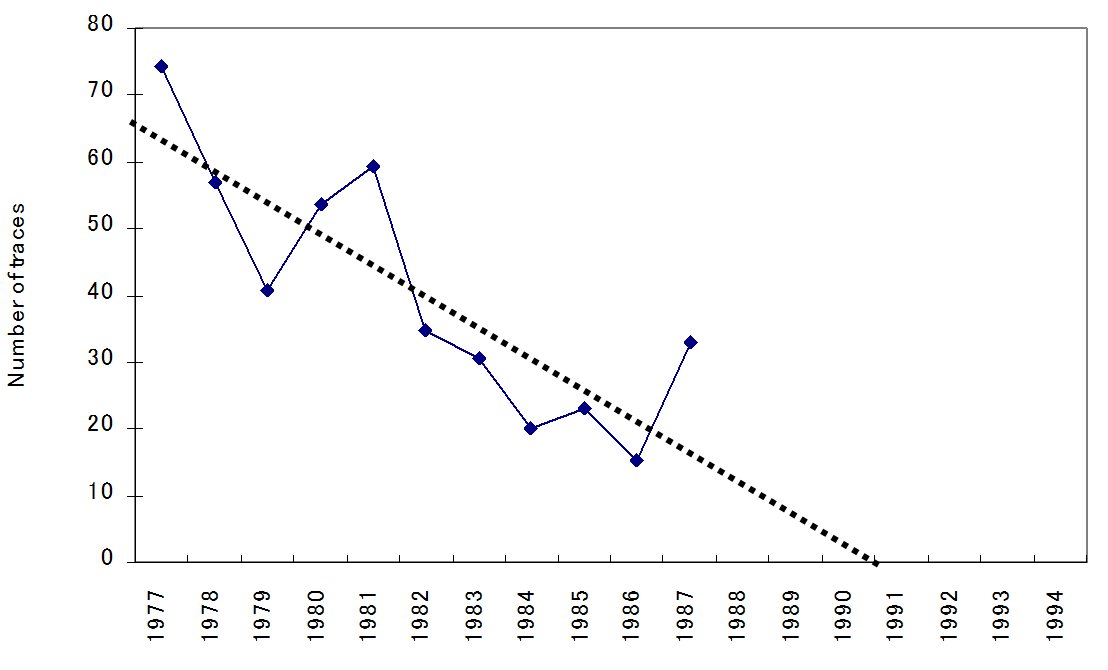
However, the otters seem to be still present in several major river systems in South and North Korea, Peoples Republic of China, Taiwan (Kinmen and Little Kinmen Island) and Mongolia, but there is little information available on the status and the distribution of these animals. Further progress and emphasis on otter awareness and research is envisaged in East Asia after the present otter colloquium.
The otter researchers in South Korea have taken several interesting and important steps on otter awareness and conservation (Roh and Han, 2000). In addition, the Eurasian otter has been designated a national monument and otter hunting is prohibited by law. In North Korea, it is known that there are healthy populations of Eurasian otter occurring in Paekdu-san and Myohyang-san, two Nature Protection Areas. Also, the local people believe that the otters inhabit the upper reaches of most of the large rivers in N. Korea. Furthermore, as a result of the requests made to the N. Korean Government, Sinyang, Daehung and Popdong areas have been declared as otter reserves (Chong and Sasaki, 2000).
The rapid industrialization of the People’s Republic of China is causing pollution of the wetlands in the country, affecting the distribution of otters significantly. Also the villagers still kill otters for their fur and organs, the latter for indigenous medicine. Therefore, strict legal protection for otter is needed urgently. In 1995, the Chinese Government promulgated 766 nature reserves, some of which include important otter habitats (Ma et al., 2000). Also, in 1996, the Ministry of Forestry of P.R. China set up China Wetland Data Monitoring System, which would help indirectly the healthy existence of otter in the wetlands of P.R. China.
Status of otters in Taiwan remains unclear (Dr Ling-Ling Lee, pers. Comm.). However, the surveys that were carried out in two islands, Kinmen and Little Kinmen, indicated that Eurasian otter is distributed throughout the former island and in many sites of the latter (Lee, 1996). However, wetland development, pollution and traffic causing death and injury continue to threaten otters' survival. Hung et al. (2004) used non-invasive molecular methods to investigate the abundance and spatial organization of the Eurasian otter in two streams, Chienpu and Hoshui-Chinsha in Kinmen island. They extracted DNA samples from fresh spraints collected seasonally along the two streams, and established that non-invasive molecular methods can be used to reveal abundance, sex ratios, spatial organization and genetic relatedness of wild otters. Also Huang et al. (2005) described eight new tetramicrosatellite loci for Eurasian otter and these new genetic markers can be useful for population genetic research on otters and help improve the resolution of individual identification using non-invasive methods.
Eurasian otter is a red-listed species in Mongolia and in the past it had been hunted heavily (Dr Atte Komonen, pers. comm.). However, there seems to be a healthy population of otter present in Nomrog Strictly Protected Area (NSPA) situated along the Chinese border in the southeastern tip of Mongolia. A project, funded by the Global Environment Facility in collaboration with Mongolian Eastern Steppe Biodiversity Project, is in progress on the ecology, distribution, etc. of the otter in NSPA.
West Asia
Very little data are available on otters in the West Asia except the information given in the Otter Action Plan 1990. It is known that Eurasian otter still exists in the Jordan river habitat including Lake Tiberias in Israel (Macdonald et al., 1986). Reuther et al. (2000) recorded the presence of Eurasian otter in the River Jordan and River Yarmuk. It is extremely important to conduct awareness programmes and surveys in West Asian countries with the participation of suitable biologists. However, as reported several times in the past, the absence of contact persons has become the major obstacle to initiate any otter conservation activities in West Asian countries.
STATUS OF SEA OTTER IN ASIA
The sea otter inhabits a small coastal area of the North Pacific Ocean from the Kamchatka peninsula of eastern Russia to northern Japan (Foster-Turley, 1990). Earlier it had a wide distribution along the rim of northern Pacific Ocean, starting from Hokkaido, Kuril Islands, the Aleutian Islands, Alaska and down to California coast. Because of the intensive hunting for fur during 19th Century, the population of sea otter drastically decreased. According to M. Ando (pers. comm.) the first sighting of sea otters in Japanese coast after the World War II took place in 1973 at Kiritappu, eastern part of Hokkaido. Until 1994 sea otter was sporadically recorded at eastern half of Hokkaido. After 1996 sighting of sea otter became more frequent at Nosappu and neighbouring coasts. This shows that either migrants have increased in number and/or they stayed longer in this region. From 1973 to 2001 seven mortalities were reported, all accidental and owing to fishing activities.
IMPORTANCE OF OTTER AWARENESS PROGRAMS IN ASIA
In Asia, the otter, despite being a top predator in the aquatic ecosystem, is an insignificant mammal, and thus receives little attention from the general public as well as the respective governments. In fact, because of its very illusive nature, many people are unaware that there is an animal of this nature living in freshwaters. The conservationists invariably focus their attention towards large mammals. Therefore, IUCN has given priority to conduct otter awareness programs in addition to the general otter surveys throughout Asia. As a consequence, the following awareness programs and the otter workshops have been carried out during the last two decades in Asia
Otter awareness programs and workshops carried out so far in Asia
| 1988 | The 1st Asian Otter Conservation Meeting | Bangalore, India |
| 1997 | Workshop on Monitoring & Surveying Otter in the Wild Conducted by the Japanese Otter Research Group In collaboration with the IUCN/SSC Asian Otter Secretariat, Sri Lanka. |
Huai Kha Khaeng Wildlife Sanctuary – Thailand |
| 1997 | Awareness Program on “Wetlands of Sri Lanka and Their Conservation” Conducted by the IUCN/SSC Asian Otter Secretariat, Sri Lanka. |
Institute of Fundamental Studies, Hantana, Kandy. |
| 1999 | Workshop on Conservation and Public Awareness of Otters Conducted by the Japanese Otter Research Group In collaboration with the IUCN/SSC Asian Otter Secretariat, Sri Lanka. |
Taiwan National University - Taiwan |
| 2002 | Workshop on Enhancement of knowledge and conservation of otters in U Minh Thuong National Park, Kien Giang Province - Vietnam. Conducted by the Japan Fund for Global Environment Corporation (JEC) & U Minh Thuong National Park Conservation and Community Development Project (1998 – 2003). |
U Minh Thuong National Park, Kien Giang Province - Vietnam. |
| 2002 | Workshop on “Otters as the Ambassador of Wetlands”. Organized by the Wildlife Trust of India and conducted by the Japanese Otter Research Group in collaboration with the IUCN/SSC Asian Otter Secretariat, Sri Lanka. |
Habitat Centre, New Delhi, India. |
| 2006 | Training Workshop on Survey Techniques and Monitoring Otter Populations Conducted by the IUCN/SSC Asian Otter Secretariat, Sri Lanka. In collaboration with The Integrated Group for Environmental Research (TIGER), Kathmandu |
Royal Chitwan National Park, Nepal. |
Workshop in Chitwan National Park, Nepal
In March 2006, a workshop was conducted in Nepal, at Chitwan National park, on the techniques of otter surveys and identification. Fifteen wildlife biologists were trained and it was a great success. Several important recommendations were made at this workshop to be forwarded to His Majesty’s Government of Nepal for consideration and implementation. The following are some of the scientific studies that were recommended to be carried out in Nepal.
- Surveys to determine distribution range of otter species in Nepal, within and outside Protected Areas and Ramsar sites.
- Ecological studies on otters to gather information necessary for long term survival of otters in the country.
Also, there were lengthy discussions on how to combat illegal trade of otter skins from Nepal through Tibet to China.
IMPORTANCE OF LEGAL PROTECTION
The enforcement of conservation legislation and initiation of long-term monitoring plans for the rare and vulnerable otter species in Asia should be given serious consideration. In some countries, especially in Southeast Asia and West Asia, legal protection of otter does not exist. In some others, although legal protection is given to the otter, it is not enforced in any significant manner. Therefore, due emphasis should be given not only to the need for legal protection of the otter and its habitats but also to the effective implementation of such protection laws by the respective governments. However, it is important to stress that otter conservation is a low priority area to the governments of developing countries, which have more important problems including poverty alleviation demanding their immediate attention. Nevertheless, in general, conservation of biodiversity has gained much recognition in the recent past in Asia, and it is important to brief the governments regarding the plight of the otter in the deteriorating wetlands and requesting immediate implementation of conservation measures.
REFERENCES
Acharya, P.M., Gurung J.B. (1994). A report on the status of common otter (Lutra lutra) in Rupa and Begnas Tal, Pokhara Valley, Tiger Paper, Regional Quarterly Bulletin on Wildlife and National Parks Management, Vol. XXI(2).
Acharya, P.M. (1997). Study of otters in Begnas and Rupa lakes of the Pokhara Valley in West Nepal. First phase research report to Nagao Natural Environment Foundation (NEF), Japan.
Acharya, P.M. (1998). Survey of status and distribution of Otter in Rapti River of Royal Chitwan National Park. A report submitted to Otter Research Group, Japan.
Acharya P. (2006). Otter and wetland conservation in Nepal. In: Rimal N.N. (ed.), Water Resources, Security and Sustainability, Seepwater, Kathmandu, Nepal, 144-149.
Ando, M., Sasaki, H. (1996). Chronology of otter extinction in Japan. Proc. IUCN/SSC Asian Otter Specialist Group meeting, Thailand. Eds. Santiapillai, C., de Silva, P.K. 1996. 53-55.
Chong, J.R., Sasaki, H. (2000). The status of Eurasian otter Lutra lutra in North Korea. Proc. Workshop on Conservation and public Awareness of otters. eds. Santiapillai, C., Sasaki, H., 108-110.
de Silva, P.K. (1991). A survey on the distribution of the otter (Lutra lutra) in some selected areas of Sri Lanka. Habitat, 6: 75-78.
de Silva, P.K. (1999). IUCN/SSC Asian Otter Secretariat. Proc. Workshop on Conservation and Public Awareness of otters. eds. Santiapillai, C., Sasaki, H., 65-66.
de Silva, P.K., Lombardi, D. (2001). Studies on otters in selected areas in Asia. Project Report. IUCN/SSC Asian Otter Secretariat & Columbus Zoological Park Association, Ohio.
Evans, M. et al. (1985). An ecological survey of the Narayani River, within the RCNP- A study of the fish distribution and their predators in particular the smooth Indian otter (Lutra perspicillata). Edinburgh University Expedition to Nepal, A report to the KMTNC, Nepal.
Foster-Turley, P., Macdonald, S.M., Mason, C.F. (eds). (1990). Otters: An action plan for their conservation. IUCN/SSC Otter Specialist Group, Gland, 126 pp.
Foster-Turley, P., Santiapillai, C. (1990). Action Plan for Asian Otters. Foster-Turley et al. (eds.), 52-63.
Foster-Turley, P. (1998). Fishing with otters - a fading tradition. Oryx 32: 2.
Huang, Chuan-Chin, Hsu, Yu-Cheng, Lee, Ling-Ling & Li, Shou-Hsien (2005). Isolation and characterization of tetramicrosatellite DNA markers in the Eurasian otter (Lutra lutra). Molecular Ecology Notes 5 (2): 314-316
Hung, C., Li, S., Lee, L. (2004). Faecal DNA typing to determine the abundance and spatial organisation of otters (Lutra lutra) along two stream systems in Kinmen. Animal Conservation 7: 301-311.
Hussain, S.A. (1998). Conservation status of otters in the Tarai and lower Himalayas of Utter Pradesh in India. Proceedings of the VIIth International Otter Colloquium. Trebon.
IUCN, (1990). IUCN Red List of Threatened Animals. IUCN, Gland, 192pp.
Kanchanasaka, B. (2001). Tracks and other signs of the hairy-nosed otter (Lutra sumatrana). IUCN Otter Spec. Group Bull. 18: 57-63.
Kanchanasaka, B. (2002). Experience of Thailand on Otter conservation and the hairy-nosed otter conservation in Toa Daeng Peat swamp forest. In: Vinh, N.X., Dang, N.X., Sasaki, H. (eds.) Proc. Workshop on Enhancement of Knowledge and Conservation of otters in U Minh Thuong National Park, Kien Giang Province, Vietnam. 95-101.
Lee, L. (1996). Status and distribution of river otters in Kinmen, Taiwan. Oryx, 30: 202-206
Lee, L. (1997). Status of otters in Taiwan. Proc. IUCN/SSC Asian Otter Specialist Group meeting, Thailand. Santiapillai, C., P. K. de Silva, (eds.). pg. 9 (Abstract).
Lubis, R. (2000). Conserving otters in in Indonesia: Approach and strategies. In: Santiapillai, C., Sasaki, H. (eds.) Proc. Workshop on Conservation and public Awareness of otters. Taiwan. 115-125.
Ma, Y., Zang, M., Sasaki, H. (1999). The status of otters in China. In: Santiapillai, C., Sasaki, H. (eds.). Proc. Workshop on Conservation and public Awareness of otters, Taiwan. 103-107.
Macdonald, S.M., Mason, C.F., Shalmon, B. (1986). A survey for otters in Israel. Oryx 20: 233-236.
Nguyen, X.D., Pham, T.A., Le, H.T. (2001). New information about the hairy-nosed otter (Lutra sumatrana) in Vietnam. IUCN Otter Spec. Group Bull. 18: 64-75.
Nguyen, X.D., Pham, T.A., Le, H.T., Sasaki, H. (2002). Results of otter survey in U Minh Thuong National Park and Vo Doi Nature Reserve. Proc. In: Vinh, N.X., Dang, N.X., Sasaki, H. (eds.) Proc. Workshop on Enhancement of Knowledge and Conservation of otters in U Minh Thuong National Park, Kien Giang Province, Vietnam. 67-75.
Poole, C.M. (2002). The first records of hairy-nosed otter from Cambodia. In: Vinh, N.X., Dang, N.X., Sasaki, H. (eds.) Proc. Workshop on Enhancement of Knowledge and Conservation of otters in U Minh Thuong National Park, Kien Giang Province, Vietnam. 101-105.
Reuther, C. (1999). Status of otters in the world with special reference to their popularity and to public relations or education activities for their conservation. Proc. Workshop on Conservation and public Awareness of otters. Taiwan.
Reuther, C., Hussain S.A. (2000). Aims and objectives of the IUCN/SSC Otter Action Plan 2000 and progress achieved in compilation with special reference to the Asian region: A report. In: Santiapillai, C., Sasaki, H. (eds.) Proc. Workshop on Conservation and public Awareness of otters. Taiwan. 139-143.
Reuther, C., Rifai, L., Qarcas, M., Abu Baker, M., Amr, S.Z. (2000). Results of an initial field survey for otters (Lutra lutra) in Jordan. IUCN Otter Spec. Group Bull. 17: 75-79.
Roh, Y., Han, S.Y. (1999). Korean otter and conservation awareness. In: Proceedings of the workshop on Conservation and public Awareness of otters. (eds.) Santiapillai, C., Sasaki, H. 65-66.
Sasaki, H. (2002). Present situation of hairy-nosed otters. In: Vinh, N.X., Dang, N.X., Sasaki, H. (eds.) Proc. Workshop on Enhancement of Knowledge and Conservation of otters in U Minh Thuong National Park, Kien Giang Province, Vietnam. 29-35.
Sivasothi, N., Nor, B.H.M. (1994). A review of otters (Carnivora: Mustelidae: Lutrinae) in Malaysia and Singapore. Hydrobiologia 285: 1-3.
Yonzon, P.B. (1998). Baseline information on wildlife of the west Seti River Valley with emphasis on bird and mammals. A report to the West Seti Hydro- Electric project. SMEC Ltd., 1998.
Résumé : Statut Des Espèces De Loutres En Region Asiatique Fin 2007
Quatre espèces de loutres fréquentent les zones humides d'Asie alors qu’une seule espèce marine, la Loutre de mer, est présente dans les zones côtières du nord du Japon. D’ailleurs, peu d'informations écologiques existent pour cette dernière. Parmi les loutres d’eau douce, les statuts de la Loutre cendrée, de la Loutre à peau lisse et de la Loutre d’Europe sont assez bien connus dans la plupart des pays excepté pour certaines régions d'Asie occidentale où il n’y a pratiquement aucune information. La Loutre de Sumatra, qui n'a pas été répertoriée depuis plus de deux décennies, a été redécouverte en Thaïlande et au Vietnam en 1999 et 2000. En 2002, les preuves de la présence de la Loutre de Sumatra ont aussi été trouvées au Cambodge. Dans les pays asiatiques fortement industrialisés, il semble n’y avoir aucune population sauvage de loutres sans doute en raison de facteurs principaux de disparition que sont la pollution et la destruction des habitats. La protection légale fait également défaut dans certains pays où les loutres sont encore tuées pour leurs organes pour la médecine douce et pour leurs peaux à des fins vestimentaires. En général, les Asiatiques ne sont pas conscients de l'importance de la Loutre dans les écosystèmes humides. Par conséquent, des efforts sont déployés pour sensibiliser, mener des programmes de formation et des enquêtes de terrain en particulier sur la Loutre de Sumatra. En mars 2006, une formation a eu lieu au Népal basée sur les techniques d'enquête de terrain et un programme similaire devrait avoir lieu au Vietnam ou au Cambodge en 2008. Des enquêtes sur les diverses espèces sont en cours en Corée du Sud, Chine, Inde (Nord & Sud) et au Sri Lanka, tandis que des travaux écologiques sur la Loutre de Sumatra sont menés en Thaïlande, au Vietnam, au Cambodge et en Indonésie (Sumatra). Plusieurs de ces projets sont financés par de petites subventions issues l’association du Zoo de Columbus (Etats-Unis), par le Groupe des Spécialistes des Loutres du Japon et l’IOSF (Royaume-Uni).
Revenez au dessus
Resumen: Estado De Las Especies De Nutrias De La Region Asiatica Al 2007
Cuatro especies de nutrias de río habitan en los humedales de Asia, y sólo una especie de nutria de mar habita en las costas de Japón, y de la cual hay poca información de su ecología. Para las nutrias de río, el estado de la nutria de garras cortas, nutria de pelo liso y nutria euroasiática es bien conocido en la mayoría de los países, excepto en los países de asía del oeste donde apenas existe información. La nutria de nariz peluda, de la cual no hubo registros durante mas de dos décadas, fue redescubierta en Tailandia y Vietnam en 1999 y 2000, respectivamente. El 2002, evidencia de la presencia de la nutria de nariz peluda fue encontrada en Camboya. En los países asiáticos altamente industrializados al parecer no habría poblaciones silvestres de nutrias, donde probablemente la contaminación y destrucción de hábitats serian los mayores factores contribuyendo a esta extinción. La protección legal es carente en algunos países y las nutrias son matadas por sus órganos para uso en medicina indígena y su piel para fabricación de abrigos. Los asiáticos en general no son conscientes de la importancia de las nutrias en los humedales. Por lo tanto, se están haciendo esfuerzos para una mayor concientización, así como programas de entrenamiento, particularmente para la nutria de nariz peluda. En Marzo del 2006 se llevo a cabo un curso de entrenamiento en Nepal sobre técnicas de muestreo y otro curso parecido se llevará a cabo en Vietnam o Camboya en el 2008. Muestreos generales de nutrias están en progreso en Corea del Sur, China, India (Norte y Sur) y Sri Lanka, mientras que estudios de la ecología de la nutria de nariz peluda se llevan a cabo en Tailandia, Vietnam, Camboya e Indonesia (Sumatra). Varios de estos proyectos están siendo financiados por pequeñas donaciones como la Organización Columbus Zoo, Estados Unidos, Grupo de Especialistas en Nutrias de Japón y el Fondo Internacional para Sobrevivencia de Nutrias, Reino Unido.
Vuelva a la tapa