 |
Last Update:
Tuesday March 3, 2015 |
| •[Home] | [Site Map] | [Contact Us]• | |
| [Home] | [Members] | [News] | [Bulletin] | [Q & A] | [Species] | [Library] |
Lutra sumatrana (Gray, 1865), the Hairy-Nosed Otter
|
|
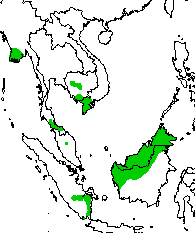
DescriptionA medium-sized otter, 95-133cm in length and weighing 5-8kg. The paws are fully webbed with well-developed claws. The fur is dark brown above, slightly paler underneath with a contrasting pale chin and upper lip. The whole nasal area (rhinarium) is covered in short, dark fur. DNA work has established that this is a true species - some authors previously considered it to be a subspecies of Lutra lutra. HabitatThis species is found in undisturbed habitats in South-east Asia. The tiny amount of information available suggests this species inhabits peat swamp forests, flooded forest, lowland Dipterocarp forest, freshwater swamp forest, and estuaries dominated by Nypa and mangroves. DistributionThis species is endemic to South-east Asia. There are recent records from various, mostly highly dispersed localities in Southeast Asia, in Thailand, Viet Nam and Cambodia, Malaysia, Brunei, and Indonesia (Sumatra and Borneo). Historical records suggest this species formerly inhabited mainland South-east Asia including Myanmar and Lao PDR, although this information is still questionable. Conservation StatusRed List Category & Criteria: Endangered, Population decreasing There is no information available about population size or the number of mature animals. There is only fragmented reliable information about the species' geographic range. Current ConcernsVery little is known, but it is likely that this species is threatened by destruction of peat swamp forests for logging and agriculture, and a very high degree of population fragmentation makes populations numerically vulnerable. Furthermore, cubs of this species have been found in several cases of pet trading in Indonesia. Research is critically needed on all aspects of this species' ecology and biology, with the population status and habitat use across the range as priority. It is protected at international and national levels, but legislation at local level, and its enforcement are urgently needed. This species is so rare that there is a good case for ex situ conservation measures (captive breeding and maintenance) to be undertaken. Leading ResearchersSource: Padma K de Silva, IUCN/SSC Asian coordinator
Key Publications
News on ThreatsUseful Links
|



| [Copyright � 2006 - 2011 IUCN OSG] | [Home] | [Site Map] | [Contact Us] |